
Government & Law Enforcement
IT and cybersecurity for local government and law enforcement, built to the standard the audit actually uses.
Boroughs, townships, counties, authorities, and police departments do not get to treat IT as a back office concern. A CJIS audit, a Right-to-Know request, a public budget hearing, and a resident population that notices when something breaks all land on the same environment.
The pattern
The environment is public. The controls usually aren't.
Most municipal environments were built one decision at a time. A part time vendor who handles the server. A borough secretary with domain admin rights because someone needed them years ago. A police network that was supposed to be segmented from the municipal side and quietly isn't. A CAD or RMS vendor who manages their piece and assumes someone else is managing everything around it.
The result is an environment where nobody can answer the questions that matter. Who has access to criminal justice information. Where body worn camera footage actually lives and whether it can be restored. What happens to tax collection and utility billing if the server is encrypted on a Friday afternoon. These are not hypotheticals. They are the questions an auditor, a carrier, or a solicitor asks, usually at the worst possible time.
Criminal justice agencies carry an obligation that private business does not. The CJIS Security Policy applies to every vendor with access to criminal justice information, and the agency is accountable for the vendor's failures, not just its own. That is why a chief cannot simply hire the cheapest available IT support. The standard has to be demonstrable before the audit, not asserted during it.
Where we focus
What we manage for public sector agencies.
7 areas, swipe or use arrows
CJIS aligned identity and access
Individual accounts, advanced authentication, admin separation, and access reviews that produce a record an auditor can read. Mobile data terminals in vehicles carry the same requirement as a desk in the station, and they are usually where the gap is.
Network segmentation
Separating criminal justice systems from general municipal operations, then documenting and verifying that separation. This is one of the most common audit findings and one of the easiest to leave half finished.
Digital evidence and retention
Body worn camera footage, case files, and digital evidence backed up, retained to your schedule, and restoration tested. Storage growth in this category outpaces every budget projection we have seen, so we plan for it rather than discover it.
Backup and recovery for public services
Tax collection, utility billing, permitting, GIS, and payroll are the systems residents notice immediately. Backups are encrypted, immutable, and tested, so recovery is a known quantity before a ransomware event makes it urgent.
Vendor coordination
CAD, RMS, e-ticketing, evidence platforms, and dispatch connections all have vendors who manage their own piece. We manage the environment around them and hold the seams together, which is where most problems actually live.
Records and Right-to-Know readiness
Email archiving, retention policy, litigation hold, and search configured so a records request or a discovery obligation can be answered without a scramble.
Audit and insurance evidence
Documentation maintained continuously for CJIS audit cycles, public entity insurance pool requirements, and grant reporting. The evidence exists on an ordinary Tuesday, not just when someone asks for it.
What should a municipality or police department look for in an IT provider?
A public sector IT provider has to meet requirements a general business MSP is never asked about. That means personnel who have cleared CJIS background screening before they touch the environment, documented controls that survive a triennial audit, retention and records handling that holds up to a Right-to-Know request, and the ability to work inside public procurement and budget cycles rather than around them. Ask any prospective provider to show you the evidence, not describe the intention. If a provider cannot tell you which of their technicians are cleared and what their screening process is, that answer is itself the answer.
CJIS
Every member of our team is CJIS cleared.
This is not a subset of our staff, and it is not handled case by case when a law enforcement client comes up. Our entire team has completed CJIS required background screening. That means the person who picks up your call, the person who touches the server, and the person on site at the station have all been through the same process.
For an agency, that removes an entire category of risk and paperwork. There is no scrambling to get a technician cleared before a project starts. There is no escorting a vendor who was never screened. There is no discovering during an audit that remote access was granted to someone who should not have had it.
We operate against the CJIS Security Policy as written: signed security addendum, personnel screening, security awareness training on schedule, FIPS validated encryption in transit and at rest, advanced authentication, defined incident reporting, and documentation that can be handed to an auditor. In Pennsylvania that means working with your agency's Terminal Agency Coordinator and supporting the audit cycle rather than reacting to it.
HOW WE WORK
One environment, two sets of obligations, one standard.
In a municipality the police department and the business side of the operation share a building, often share a network, and absolutely do not share the same requirements. Criminal justice information carries obligations that the tax office does not. Treating the whole thing as one flat network is the most common finding we see.
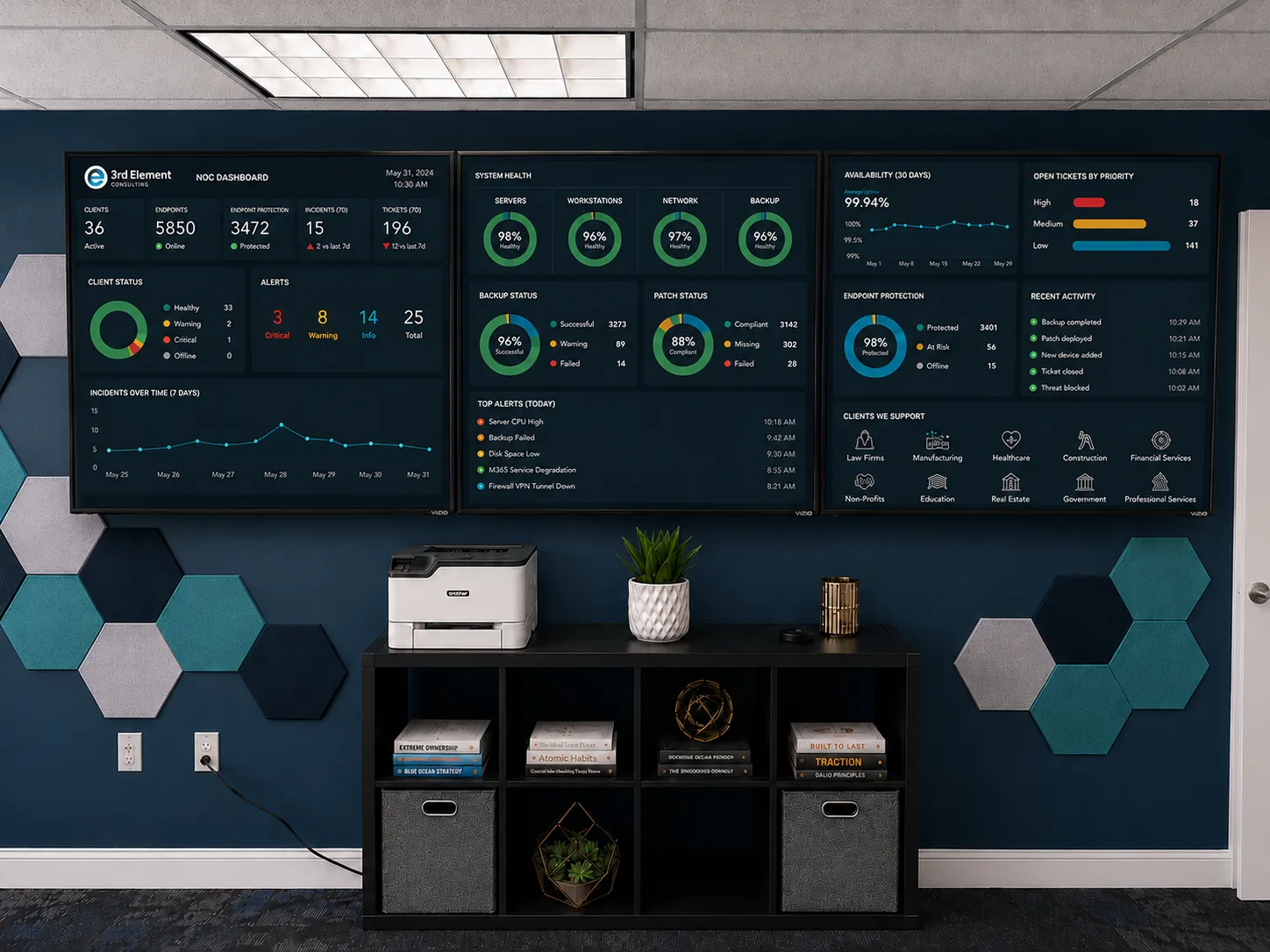
We manage the full environment against a documented baseline. Identity, devices, email, file systems, backup, cloud, and network segmentation are each set to a standard and reviewed on a schedule. When something falls out of standard it gets corrected. Nobody is closing tickets and assuming the underlying condition is resolved.
We work alongside your existing CAD and RMS vendors, your evidence platform, your 911 or county dispatch connection, and your insurance pool. We do not require you to replace relationships that work. We manage the parts that need managing and coordinate the rest.
For agencies across Central Pennsylvania, Harrisburg, Mechanicsburg, Carlisle, York, Lancaster and the surrounding counties, we are local enough to be on site when it matters and structured enough to handle everything else remotely.
WHAT CHANGES
What looks different once the environment is under management.
- The audit has an evidence package. Access records, training records, encryption configuration, and incident response documentation exist before the auditor asks, not assembled in a panic the week before.
- The police network is actually separated. Segmentation between criminal justice systems and general municipal operations is designed, documented, and verified, not assumed because it was set up that way once.
- Evidence retention is a control, not a hope. Body worn camera and digital evidence storage is backed up, retention aligned to your schedule, and restoration tested. You know what you have and how long it takes to get it back.
- Nobody shares a login. Shared accounts in the squad room and on mobile data terminals are replaced with individual identities and advanced authentication, which is both a CJIS requirement and the only way an access log means anything.
- Offboarding closes the same day. When an officer, employee, or elected official leaves, access ends that day. Not at the end of the month.
- Right-to-Know requests have a process. Email retention, archiving, and search are configured so a records request is a task, not an emergency.
- The insurance and pool renewal has answers. The control questions carriers and public entity pools are tightening every year have documented evidence behind them.
Skip this and nothing looks wrong, right up until it does. A shared login stays in use. An unsegmented network stays unsegmented. Evidence storage that was never tested fails when a case depends on it. An audit finding, a records request, or an incident is usually what brings it to the surface.
Who we work best with
Built for government & law enforcement that want IT held to a standard.
Something brought you here. If you're with an organization of about 10 to 250 employees, headquartered in or operating across Central PA, that depends on its technology to operate and is ready to run to a standard, you've probably outgrown whoever was managing IT before or something specific made the gap visible.
A strong fit
- Boroughs, townships, and municipal authorities that have outgrown a part time IT arrangement
- Municipal and regional police departments that need CJIS aligned support with cleared personnel
- County agencies and public authorities running systems residents depend on
- Agencies preparing for a CJIS audit or a public entity insurance pool renewal
- Public entities where one person has been holding the whole environment together and everyone knows it
Not the right fit
- Buyers shopping on rate alone
- Companies that want a vendor to do only what they are told.
- Organizations not ready to put security or standards in place.
Common questions
Questions leadership usually asks first.
Continue reading
Related work and reading.
Client Story: Moving a Regional Police Department Without Stopping a Shift
New workstations, a consolidated server footprint, and a full data migration, with officers patrolling through all of it.
Read more: Client Story: Moving a Regional Police Department Without Stopping a ShiftHIPAA, CJIS and CMMC Compliance Explained
What each framework actually requires, and where agencies most often assume a control exists that does not.
Read more: HIPAA, CJIS and CMMC Compliance ExplainedStandards and Security Baseline
The documented baseline every environment we manage is held to, and reviewed against on a schedule.
Read more: Standards and Security BaselineCompliance and Governance
Evidence maintained continuously, so an audit is a retrieval exercise rather than a project.
Read more: Compliance and GovernanceBackup and Recovery
Encrypted, immutable, tested backups for the systems residents notice the moment they stop working.
Read more: Backup and RecoveryCybersecurity
Managed detection, endpoint control, and the access discipline an access log depends on.
Read more: CybersecurityAI Readiness and Governance
Report writing and transcription tools are entering agencies fast. Inventory and approve them before they touch case data.
Read more: AI Readiness and GovernanceIT Support for Local Government and Police Departments in Harrisburg, PA
How this standard applies across Harrisburg and Dauphin County.
Read more: IT Support for Local Government and Police Departments in Harrisburg, PAIT Support for Local Government and Police Departments in York, PA
Standards-led support for municipalities and police departments across York County.
Read more: IT Support for Local Government and Police Departments in York, PAIT Support for Local Government and Police Departments in Carlisle, PA
Local coverage for agencies in Carlisle and Cumberland County.
Read more: IT Support for Local Government and Police Departments in Carlisle, PANext step
Get a clearer view of your IT environment.
Find out what is working, where the risks are, and what needs attention next.