
Co-Managed IT
Support for internal IT that is carrying too much alone.
Most internal IT leads are not under-skilled, they are under-supported. Co-managed IT gives them senior depth, better tooling, and a shared standard so the environment isn't sitting on one person or small team.
3rd Element Consulting provides co-managed IT services in Central Pennsylvania and nationwide for organizations of any size with at least one internal IT person, from a single IT generalist to a small internal team. The arrangement is shaped around what your team needs, not a fixed model we decide for you.
The pattern
When one person becomes the single point of failure.
Internal IT often starts as one capable person who knows the systems, the people, and the workarounds. As the business grows, that person ends up owning everything, help desk, security, Microsoft 365, vendors, projects, planning, and the gaps only show up when they take a week off.
Co-managed IT is not about replacing that person. It is about making sure the environment, the security posture, and the planning do not live entirely in one place.
Where we plug in
We take the parts that should not rest on one person.
9 areas, swipe or use arrows
Escalation support
Senior engineers behind your internal lead for the issues that take real time, real depth, or after-hours coverage.
Cybersecurity oversight
Standards, controls, and review cycles aligned to CIS Controls, and to whatever insurers or customers are asking about.
Microsoft 365 management
Identity, sharing, mailboxes, licensing, and security configurations held to a written standard.
Backup and recovery
Monitoring, restore testing, and recovery planning so backups stop being something everyone hopes is fine.
Monitoring and alert follow-up
Alerts triaged and acted on, not just routed to a busy inbox.
Vendor coordination
We take the back-and-forth with ISPs, line-of-business apps, and hardware vendors off your internal team.
Project and lifecycle support
Senior help on migrations, refreshes, office moves, and the work nobody has bandwidth for.
Documentation the team can use
What exists, how it is configured, what changed, kept current and shared with your internal lead.
Leadership planning
Quarterly reviews with the people who actually decide budget, hiring, and what comes next.
How it works
Responsibilities written down, not assumed.
We start by understanding how the internal team operates today, what they own, what they wish they could hand off, and where the environment is exposed.
Then we agree on responsibilities in writing. The internal team keeps what they should keep. We take the rest, and the boundary is clear enough that nothing falls between the seats.
Reviews happen on a regular cadence with the internal lead and leadership. Adjustments are normal, the model is built to flex with the business.
What co-managed IT is not
We do not show up to replace your team or compete with them.
Good internal IT people are a real asset. Co-managed IT works because we are aligned with them, not positioned against them. The point is to give them backup, better tools, and a standard the business is held to, so they can focus on the work that actually requires them. If the internal role ever changes, this same engagement can shift to fully managed IT without changing providers.
An example split
A starting point, not a fixed model.
- Internal IT might own: daily user support, business application knowledge, employee onboarding, and the relationships that depend on company context.
- 3rd Element might own: senior escalation, cybersecurity oversight, Microsoft 365 management, backup and recovery, monitoring, vendor coordination, and project support.
- Shared responsibility: documentation, planning, and regular reviews, with each side's ownership written down so nothing falls between them.
Every co-managed engagement starts by defining responsibilities with the client. The actual split can change as the team, environment, or priorities change. Tools, coverage hours, and escalation paths are designed the same way, around what your team needs.
One documented baseline
A shared environment still works to one standard.
The internal team and 3rd Element work from the same documented baseline. Identity, Microsoft 365, backups, monitoring, security controls, and lifecycle work do not get separate expectations depending on who handles the task.
That shared standard makes the boundary visible. Each side can see what is configured, what changed, what needs attention, and who owns the next step.
Tooling and visibility
Shared access, current documentation, fewer blind spots.
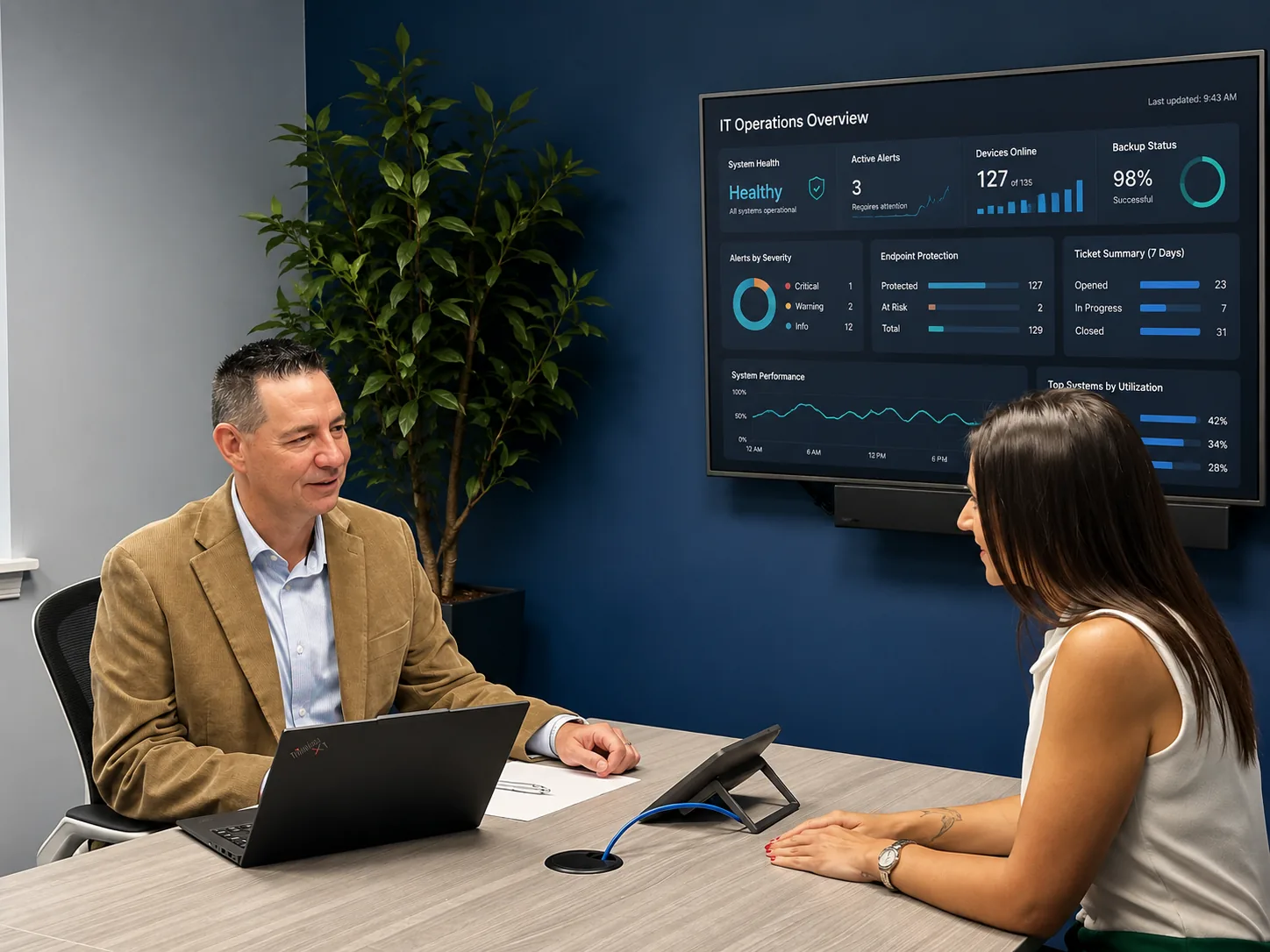
Depending on how the engagement is designed, your internal team can have shared access to the monitoring, documentation, backup, and security tools we use. Alerts are triaged and acted on, documentation stays current, and reviews include both the internal lead and leadership.
The goal is not to put another layer between internal IT and the environment. It is to give the team better visibility and senior depth without taking away the context they already have.
Who we work best with
Built for companies that want IT held to a standard.
Co-managed IT works best when leadership wants to put the internal team in a stronger position, not just reduce their workload, but give them the depth and backup the environment actually needs.
A strong fit
- Organizations of any size with at least one dedicated internal IT person
- A single IT generalist or a small internal team that needs added depth or coverage
- Growing companies whose IT lead is now also the security, M365, and vendor lead
- Environments that need real cybersecurity oversight without hiring for it
- Internal teams that want a senior partner, not a vendor that talks past them
How we work
- We price for the outcome, not the lowest monthly rate. If price is the only deciding factor, we're probably not the best match.
- We'll tell you when something needs attention, even if you didn't ask.
- Every client runs to a security baseline: MFA, patching, and tested backups. We don't make exceptions, because we're accountable for the result.
In their words
We joined up with 3rd Element Consulting to assist with a Microsoft 365 project. We were very impressed with their level of expertise and customer service. 3rd Element has become an integral part of our IT team, providing consulting services, system support, and providing backup for our onsite team. We have recommended 3rd Element Consulting to many other companies. We look forward to a long and prosperous partnership with 3rd Element Consulting.
Common questions
Questions leadership usually asks first.
What exactly are co-managed IT services?
Will you take work away from our IT person?
Can the responsibility split change over time?
What happens when our internal IT person is out or leaves?
How does escalation work?
Do we lose visibility into what is happening?
Can co-managed turn into fully managed later?
Can you help with cyber insurance questions if we have internal IT?
What is an IT Environment Review for Co-Managed IT?
Continue reading
Related work and reading.
In Harrisburg: Co-Managed IT
How this work applies for Harrisburg and Dauphin County organizations.
Read more: In Harrisburg: Co-Managed ITClient Story: Building a WISP That Would Hold Up
An internal IT team knew the environment. We added the regulatory specialization and capacity to turn that knowledge into defensible documentation.
Read more: Client Story: Building a WISP That Would Hold UpClient Story: Days Before Opening, the IT Person Disappeared
What happens when one person holds all the knowledge and access, and they go away days before a critical opening.
Read more: Client Story: Days Before Opening, the IT Person DisappearedManaged IT Services
The fully managed version many co-managed engagements evolve into when internal IT changes.
Read more: Managed IT ServicesCo-Managed vs. Fully Managed IT: Which One Fits Your Business?
Decide which model fits before you go looking, so you're comparing the right thing.
Read more: Co-Managed vs. Fully Managed IT: Which One Fits Your Business?Standards & Security Baseline
The written standard co-managed engagements hold environments to, so responsibilities and expectations are clear.
Read more: Standards & Security BaselineIT Support, Wherever You Are
Senior co-managed depth for internal teams located well outside Central PA.
Read more: IT Support, Wherever You AreEmpowering Your Internal IT: How Co-Managed Security Bridges the Governance Gap
Where the governance work sits when an internal IT lead is already carrying daily operations.
Read more: Empowering Your Internal IT: How Co-Managed Security Bridges the Governance GapDawn Sizer Wrote for Managed Services Journal on Scaling an MSP Without Losing the Standard
Why documentation, not talent, is what keeps a standard intact as a team grows.
Read more: Dawn Sizer Wrote for Managed Services Journal on Scaling an MSP Without Losing the StandardNext step
Get a clearer view of your IT environment.
Find out what is working, where the risks are, and what needs attention next.