
Cybersecurity
Security built into how IT is managed, not bolted on after.
Most security incidents are not exotic. They come from gaps that were known about, accepted, or left with no one responsible for closing them. IT managed to a written standard closes those before they become a problem.
3rd Element Consulting provides managed cybersecurity for small and midsize businesses across Pennsylvania, typically with about 10 to 250 employees, from our base in Mechanicsburg. Instead of a separate security vendor, security is built into how we manage IT every day, held to a written baseline aligned to the CIS Controls and reviewed as the business changes. That covers user accounts and sign-ins, endpoints, Microsoft 365, email, backups, vendor access, and incident response planning.
Most of what we do is unglamorous on purpose: the controls that stop the common attacks, kept in place month after month, with evidence you can show an insurer or a client.
The pattern
When security is treated as optional, it becomes optional.
Security gets dangerous when it lives in a separate column from day-to-day IT. MFA was almost rolled out. Backups are probably fine. The former employee was probably removed. Almost and probably are not a security posture.
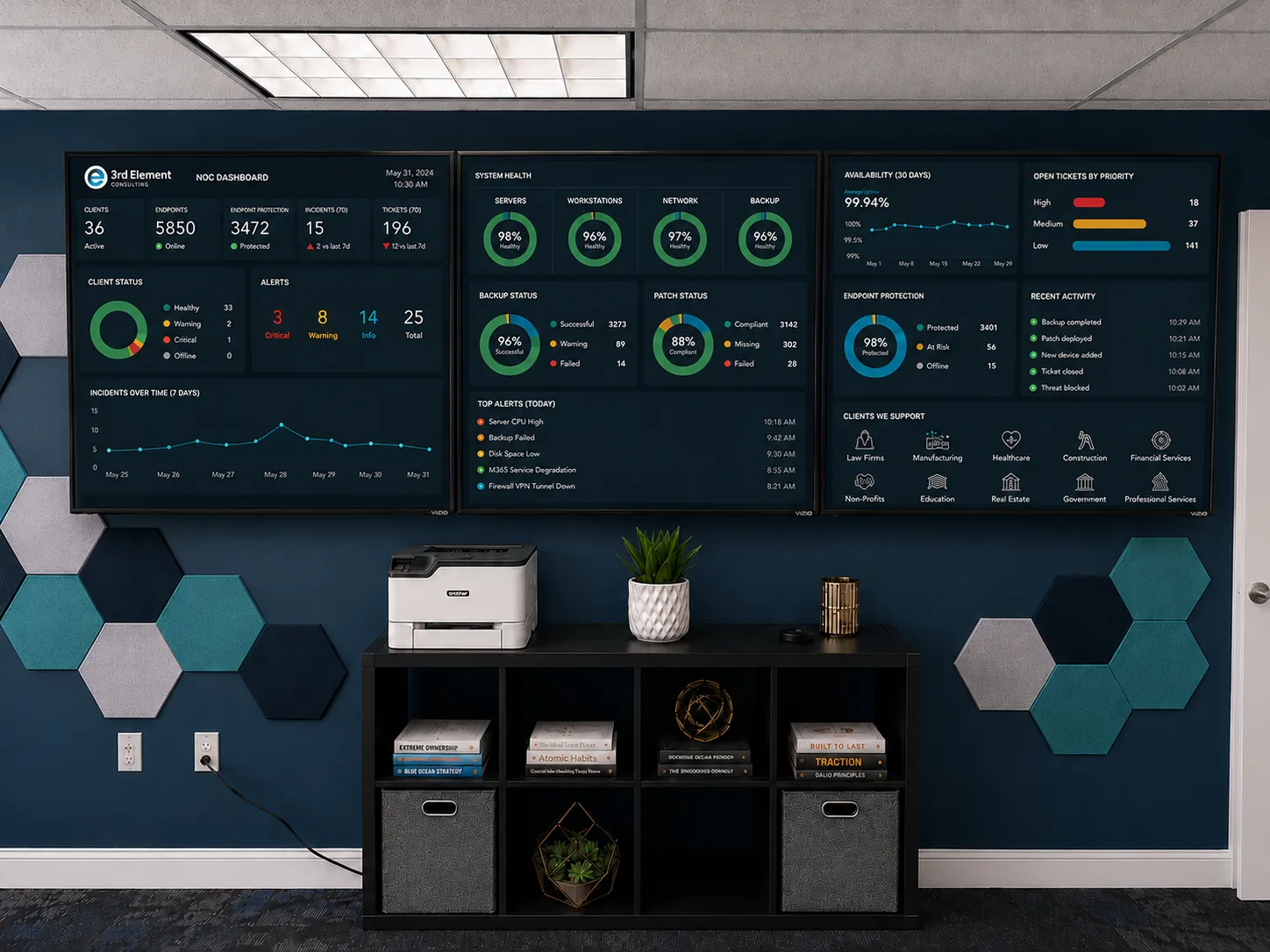
We treat security as part of how the environment is run, endpoint, identity, email, network, backup, access, held to a written baseline and reviewed as the business changes.
What we own
Where we focus protection.
9 areas, swipe or use arrows
User accounts and sign-ins
MFA, conditional access, password posture, and offboarding, so a credential leak is not an incident.
Endpoints and servers
Modern endpoint protection, hardening, patching, and least privilege on the devices people actually use.
Microsoft 365
Mailbox rules, sharing, external access, audit logging, and admin roles configured to a written standard.
Data and private information
Where sensitive data lives, who can reach it, and how it leaves the company, reviewed, not assumed.
Backups and recovery
Backups protected from the same attack that hit the systems they back up, and tested for real recovery.
Vendors and third-party access
External logins, contractor accounts, and integrations reviewed against the access they actually need.
Alerts and follow-up
Security alerts triaged and acted on by people, not lost in a busy inbox.
Incident response planning
A written plan for who does what, in what order, when something does go wrong.
Insurance and customer questions
Translated into the controls they actually mean, so answers come from evidence, not guesswork.
How we work
Review, prioritize, put controls in place, then keep them in place.
We start with a clear-eyed look at the current environment, what is protected, what is exposed, and what is being asked of you by insurers, customers, and auditors. When those questions need documented governance behind the technical answers, we can pair the security work with that too.
From there, the highest-risk gaps get attention first. Controls go in with a plan for how they will be maintained, not as a one-time project. Security only stays real when it is managed. That includes how we protect our own access. If you are comparing providers, our guide explains how to choose a cybersecurity company.
What changes
Security stops being a quarterly anxiety.
Insurance applications are answerable. Customer security questionnaires stop derailing a week. The team stops finding out about former employees still in the environment. Leadership has a posture they can describe in plain language, and defend.
Who we work best with
Built for companies that want IT held to a standard.
Something brought you here. If you're with an organization of about 10 to 250 employees, headquartered in or operating across Central PA, that depends on its technology to operate and is ready to hold its IT to a written standard, you've probably outgrown whoever was managing IT before or something specific made the gap visible.
A strong fit
- Leadership is ready to treat IT as part of how the business runs.
- Teams tired of explaining the same problems to the same provider.
- Operations where downtime, lost data, or a security event would put the business at risk.
- An internal IT person who can't be a specialist in every area and doesn't have visibility into how other organizations solve the same problems.
How we work
- We price for the outcome, not the lowest monthly rate. If price is the only deciding factor, we're probably not the best match.
- We'll tell you when something needs attention, even if you didn't ask.
- Every client runs to a security baseline: MFA, patching, and tested backups. We don't make exceptions, because we're accountable for the result.
Common questions
Questions leadership usually asks first.
What should a small business in Pennsylvania look for in a cybersecurity company?
Do we need a separate cybersecurity vendor?
Can you help with cyber insurance questions?
Can you help with Microsoft 365 security?
What framework do you align to?
What is an IT Environment Review?
Continue reading
Related work and reading.
In Harrisburg: Cybersecurity Services
How this work applies for Harrisburg and Dauphin County organizations.
Read more: In Harrisburg: Cybersecurity ServicesStandards & Security Baseline
The non-negotiable floor the cybersecurity work is measured against, in writing.
Read more: Standards & Security BaselineGovernance, Risk & Compliance
The documentation layer that lets you prove the security posture to a regulator, insurer, or client.
Read more: Governance, Risk & ComplianceCyber Insurance Readiness
Answer insurer questions using the same controls this work puts in place.
Read more: Cyber Insurance ReadinessMicrosoft 365 security gaps most businesses miss.
Where modern risk actually lives: identity, mailboxes, sharing, and mobile access.
Read more: Microsoft 365 security gaps most businesses miss.3rd Element Consulting Featured in a ThreatLocker Customer Success Story
What a default-deny posture looks like in a real client environment.
Read more: 3rd Element Consulting Featured in a ThreatLocker Customer Success StoryDawn Sizer Wrote for Managed Services Journal on the Top Cybersecurity Threats of 2025
Why small businesses end up the easier target, in our CEO's words.
Read more: Dawn Sizer Wrote for Managed Services Journal on the Top Cybersecurity Threats of 2025Next step
Get a clearer view of your IT environment.
Find out what is working, where the risks are, and what needs attention next.