
Virtual CIO
Technology decisions tied to business goals, not whoever called last.
Most IT relationships stop at tickets. Budget planning, risk-based prioritization, and a roadmap tied to where the business is going never happen because nobody owns that layer. A vCIO does.
3rd Element Consulting provides virtual CIO services, owning technology budgeting, risk prioritization, and a multi-year roadmap tied to where the business is going.
The pattern
Support keeps the lights on. Nobody is planning three steps ahead.
Most businesses have IT support handling day-to-day issues, and that's necessary, but it's a different function from deciding what the business should invest in next, what risk is worth carrying, and how technology should change as the company grows.
If the role is new to you, our plain-language guide on what a virtual CIO actually does covers the function before the title. Most planning starts from a documented baseline, which is what an IT audit covers.
Without someone owning that layer, technology decisions get made reactively. A system fails and gets replaced, a vendor pushes a renewal and it gets signed, an acquisition happens and IT finds out after the fact. None of it is connected to a plan, because there isn't one.
Leadership ends up making budget decisions without a clear picture of what's aging, what's exposed, or what the next 12 to 24 months actually require. The result is spending that reacts to emergencies instead of a roadmap that prevents them.
What we own
What a vCIO engagement covers.
7 areas, swipe or use arrows
Technology roadmap and budget planning
A multi-year view of what needs to be replaced, upgraded, or invested in, tied to the business plan instead of built one emergency at a time.
Quarterly business reviews
Structured reviews with leadership covering risk, spend, lifecycle, and what's coming next, on a cadence the business actually keeps.
Risk prioritized in business terms
Technical risk translated into what it means for revenue, operations, and exposure, so leadership can make an informed call, not just a technical one.
Vendor and contract strategy
Reviewing what you're paying for against what you actually need, and negotiating from a position of knowing the alternatives.
Growth and transaction support
Technology diligence for acquisitions, new locations, or a transaction, so IT is not the thing that surfaces a problem after the deal is done.
Board and leadership-level reporting
Reporting built for the people making decisions about budget and risk, not a technical summary nobody outside IT can use.
Compliance and insurance alignment
Making sure the technology roadmap accounts for what regulators, insurers, and clients are going to ask for next, not just what's required today.
HOW WE WORK
Quarterly ownership of where technology is headed, not just where it is today.
We start by understanding where the business is going, growth plans, acquisitions, new locations, compliance requirements on the horizon, not just what's broken today.
From there we build a technology roadmap tied to those goals: what needs to be replaced, what needs to scale, what risk needs to be addressed before it becomes a problem, and what it will cost, laid out far enough in advance that it's a planning conversation, not an emergency.
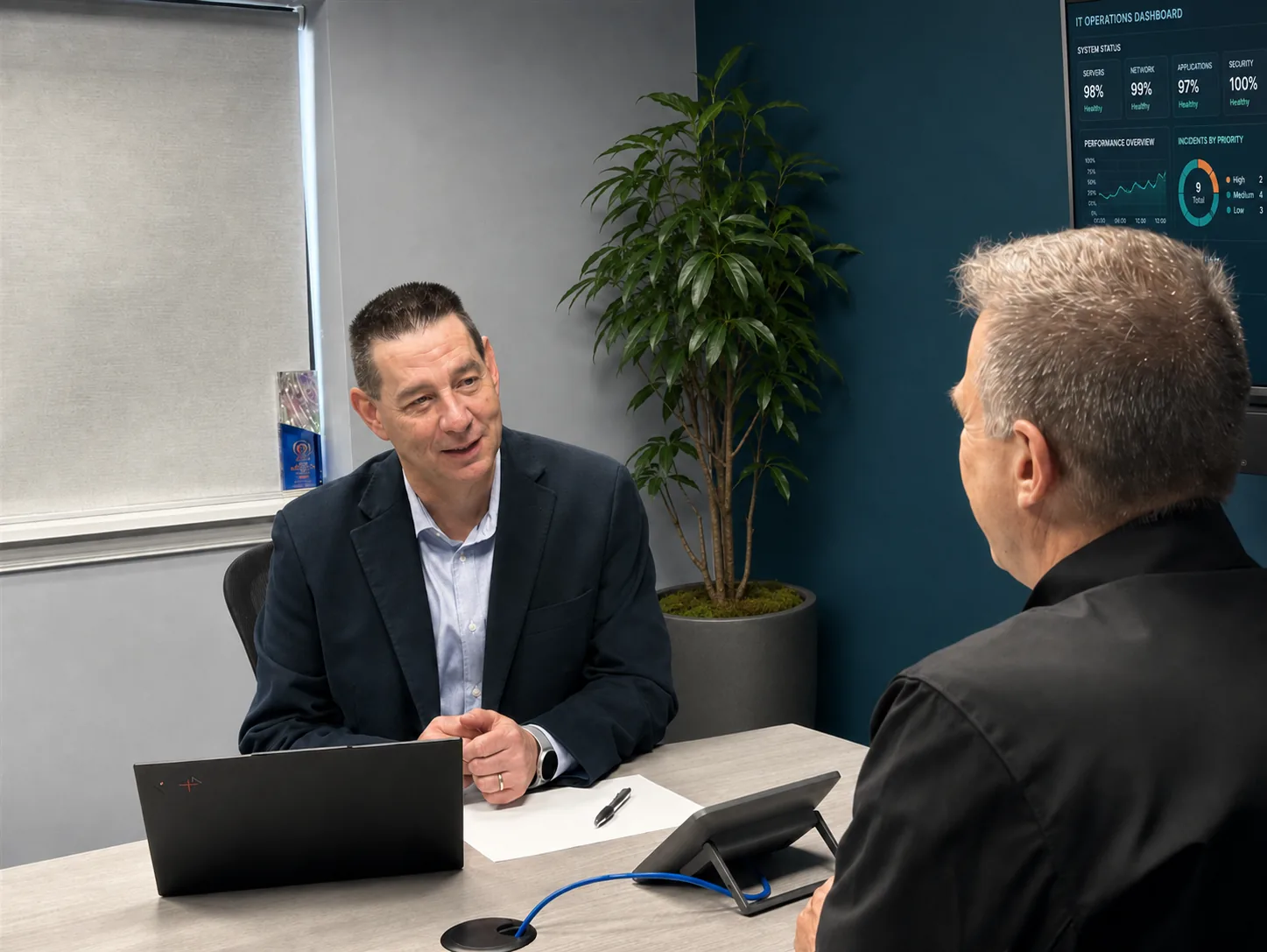
We meet with leadership on a cadence the business keeps, translate technical risk into business language, and revise the plan as the business changes. This works whether we're your managed IT provider, your co-managed partner, or brought in specifically for the strategic layer alongside an internal team.
WHAT CHANGES
What leadership notices first.
- Budget conversations start from a plan. Lifecycle, renewals, and security investments are surfaced in time to plan, not in time to panic.
- Risk gets prioritized in business terms. Leadership hears what a gap actually means for the business, not a list of technical findings with no context.
- Growth doesn't outrun the technology. New locations, acquisitions, and headcount growth are planned for before they create a scramble.
- Vendor decisions are strategic, not reactive. Contracts and renewals get evaluated against the roadmap, not signed because a renewal notice showed up.
- Leadership has one person who can answer the technology question in a board meeting or an investor conversation. Not a summary assembled the night before.
- Skip this and someone still ends up deciding, just not on purpose. A renewal notice picks the vendor. A crisis picks the priority. A new hire's old habits pick the standard. None of it adds up to a plan, and the bill for that usually comes due when a transaction, an audit, or a growth plan needs an answer nobody has ready.
Who we work best with
Built for companies that want IT held to a standard.
Something brought you here. If you're with an organization of about 10 to 250 employees, headquartered in or operating across Central PA, that depends on its technology to operate and is ready to hold its IT to a written standard, you've probably outgrown whoever was managing IT before or something specific made the gap visible.
A strong fit
- Leadership that wants technology decisions tied to business strategy, not vendor pressure
- Businesses with internal IT or a managed IT provider handling support, but no one owning the strategic layer
- Companies planning growth, an acquisition, or a transaction that needs a technology roadmap behind it
- Organizations that want board-level reporting on technology risk and spend
How we work
- We price for the outcome, not the lowest monthly rate. If price is the only deciding factor, we're probably not the best match.
- We'll tell you when something needs attention, even if you didn't ask.
- Every client runs to a security baseline: MFA, patching, and tested backups. We don't make exceptions, because we're accountable for the result.
Common questions
Questions leadership usually asks first.
Do we need this if we already have managed IT or an internal team?
How is this different from co-managed IT?
How often do we meet?
Can a vCIO help with a transaction or acquisition?
Can you help with cyber insurance questions?
What is an IT Environment Review?
Continue reading
Related work and reading.
Client Story: Days Before Opening, the IT Person Disappeared
Single-point-of-failure IT in practice: one undocumented environment, one person, and an opening deadline that could not move.
Read more: Client Story: Days Before Opening, the IT Person DisappearedCo-Managed IT Services
vCIO strategy pairs naturally with co-managed operations when you already have an internal IT lead.
Read more: Co-Managed IT ServicesManaged IT Services
When we run day-to-day IT, the vCIO layer sits on top with the same roadmap and reporting.
Read more: Managed IT ServicesGovernance, Risk & Compliance
Governance and audit-ready evidence belong in the same strategic conversation as budget and roadmap.
Read more: Governance, Risk & ComplianceWhat Is a Virtual CIO? A Plain-Language Guide
What the role covers, and what it looks like month to month.
Read more: What Is a Virtual CIO? A Plain-Language GuideThe Strategic Bridge: Why Growing Businesses Treat IT as Infrastructure, Not an Expense
The shift in how leadership frames technology spending as the business grows.
Read more: The Strategic Bridge: Why Growing Businesses Treat IT as Infrastructure, Not an ExpenseIT Budgeting for 2027: Where to Actually Prioritize Tech Spend
A way to sort next year's spending into non-negotiable, coming due, and strategic bet.
Read more: IT Budgeting for 2027: Where to Actually Prioritize Tech SpendNext step
Get a clearer view of your IT environment.
Find out what is working, where the risks are, and what needs attention next.