
Lebanon
Managed IT for Lebanon County businesses that need IT to run as reliably as the operation does.
Lebanon County runs on manufacturing, food processing, and businesses that have been here for generations. The common thread is leadership that wants IT accountable to a standard. Not managed reactively until something forces a conversation.
The pattern
An environment built for a smaller operation doesn't hold together as the business grows.
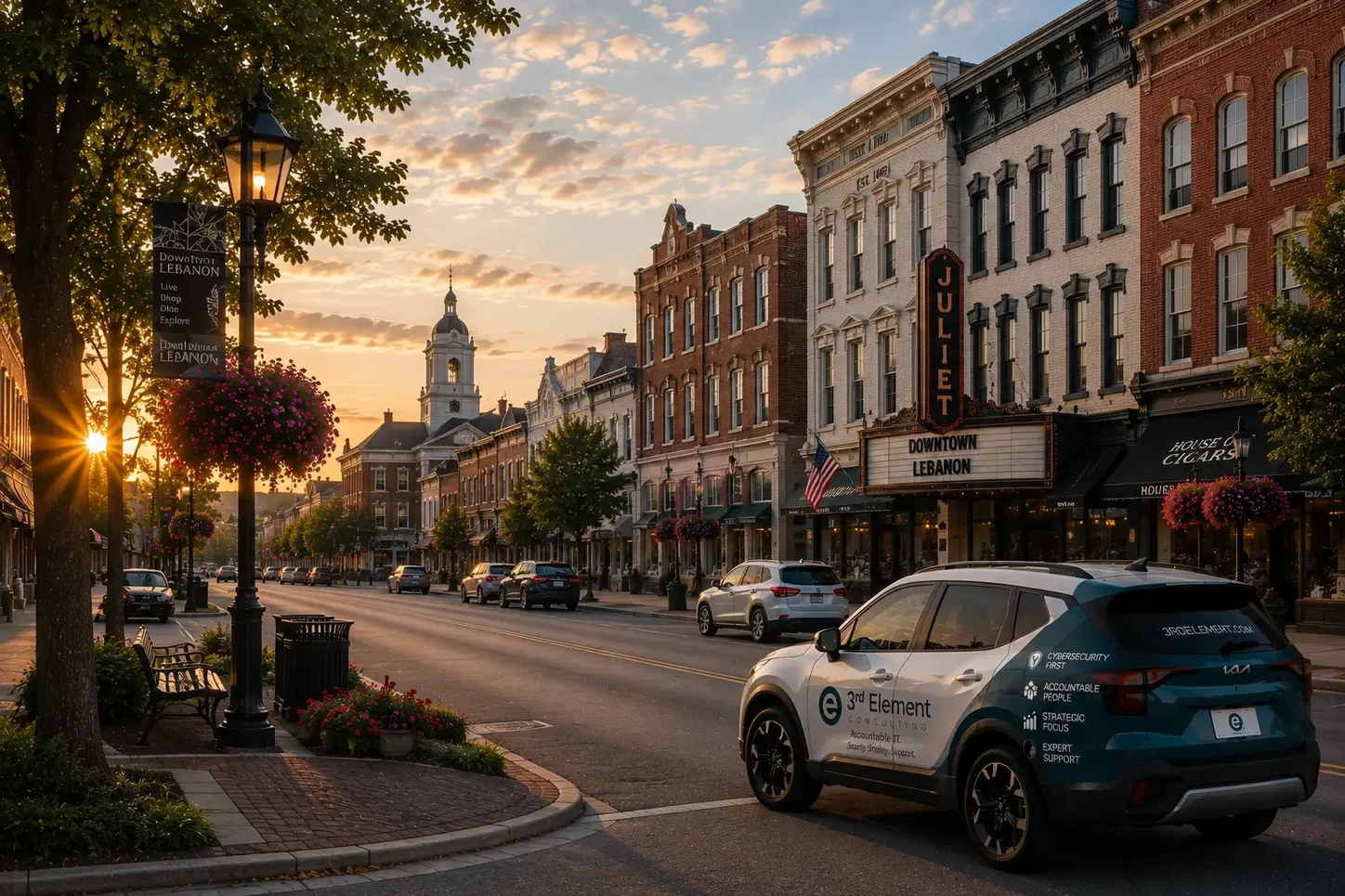
Most Lebanon County businesses didn't design their IT environment. They built it alongside the business. Manufacturing alone employs over 9,000 people here, the county's second-largest sector behind healthcare, and food processing runs deep in that identity. Systems added as the headcount grew, a provider who covered the basics, equipment that's been running since the last upgrade nobody planned for. It worked well enough until it didn't.
Manufacturing and food processing operations feel IT failure directly. A network outage doesn't slow the office. It affects the line. Our work with manufacturing technology environments accounts for that operational impact. A backup that was never tested isn't a theoretical concern. It's a recovery timeline that applies to systems the operation can't run without. Most businesses don't find out what that timeline actually is until they need it.
The county spreads the work out. Palmyra and Annville sit close enough to Hershey that staff, suppliers, and clients cross the Dauphin County line daily. The distribution corridor running from Palmyra up toward Jonestown and the Interstate 81 interchange has drawn real third-party logistics operations, GXO and DHL Supply Chain among them, which raises the bar on network reliability and warehouse system uptime for everyone supplying and servicing them. Our page on technology for logistics companies covers those operational requirements. Myerstown holds a steady manufacturing and food processing base toward the Berks line, and Cornwall's iron heritage left behind an industrial base that never fully left. Fort Indiantown Gap adds a large institutional presence north of Annville, and the businesses that support it inherit security expectations they didn't set.
Lebanon County businesses also tend to have supplier and customer relationships that extend east toward Reading and the Lehigh Valley as readily as they pull west toward Harrisburg. An IT environment set up for the Lebanon office and assumed to work everywhere else usually has gaps wherever nobody looked.
What we manage
IT held to one standard across your whole environment.
6 areas, swipe or use arrows
Microsoft 365 management
Identity, sharing, mailboxes, and licensing managed against a written standard. Most environments have settings that were configured when the account was set up and haven't been looked at since.
Backup and recovery
Monitored backups, real restore testing, and a recovery plan leadership can defend. For manufacturing and food processing operations in Lebanon County, recovery timelines have operational consequences that go beyond data loss.
Vendor coordination
ISPs, line-of-business apps, and operational technology vendors handled so your team isn't in the middle. When a vendor has an issue, there's someone who knows the full environment and drives the resolution.
Planning and budgeting
Lifecycle, renewals, and security investments surfaced in time to plan, not in time to panic. Equipment that's been running since the last provider set it up and nobody has tracked since.
Day-to-day support
Responsive help with root-cause follow-through, not the same ticket every month and not attention that reflects how far Lebanon sits from the provider's main territory.
Cybersecurity baseline
Endpoint, identity, email, and network controls aligned to CIS Controls. Security built into how the environment is managed, not added on when something forces the issue.
Local presence, broader reach
Between two markets. Covered by neither. That's where we come in.
We are based in Mechanicsburg, about 35 minutes west of Lebanon on Route 422. Close enough to be on-site the same day when something needs hands on equipment or a person in the room. Lebanon County is a real part of the service area. Not a market we claim and underdeliver.
Most day-to-day support happens remotely so help arrives quickly regardless of where your team is sitting. For Lebanon County businesses with operations, suppliers, or customers that extend east toward Reading and the Lehigh Valley, the standard we apply here gets applied everywhere the business operates. Lebanon sits inside the broader Central PA region we cover from Mechanicsburg.
What changes
IT stops falling through the gap.
The same problems stop coming back. Recurring issues get addressed at the root, not closed at the ticket and left to return next month.
Security questions have real answers. Clients, insurers, and auditors get documented evidence, not approximations from a provider who hasn't looked closely in months.
The full operation runs to one standard. What's in place in Lebanon gets applied to every location, every remote employee, every supplier relationship that extends east or west.
Backup and recovery have been tested. For manufacturing and food processing operations, the answer to how long recovery takes exists before something forces the question.
Leadership knows what's in place. What's configured, what it covers, and what the plan is when something goes wrong. That answer exists before an incident makes it urgent.
Vendors get managed, not tolerated. When a vendor has an issue, there's someone coordinating the resolution. Your team isn't caught between two providers who each think it's the other's problem.
IT stops requiring leadership attention to function. The environment runs. When something needs attention, it gets addressed before it becomes an interruption.
If none of this is in place, the gaps don't announce themselves. A backup that was assumed to exist fails when production is down. Access that was never reviewed after someone left stays open. A provider who claims the territory but doesn't prioritize it leaves things accumulating until something forces the issue. In a market that falls between two larger ones, that moment tends to arrive later than it should.
Who we work best with
Who we work best with in Lebanon and Lebanon County.
Something brought you here. If you're with an organization in Lebanon County with about 10 to 250 employees that depends on its technology to operate and is ready to hold its IT to a written standard, you've probably noticed the attention doesn't match what the business needs. A provider who covers Harrisburg well and Lebanon County when they get around to it. A recurring problem that never fully resolves. An environment coasting on whatever was set up when the business was smaller.
A strong fit
- Businesses with supplier and customer relationships that extend east toward Reading and the Lehigh Valley
- Companies that have outgrown reactive support and the provider that came with it
- Organizations that want IT accountable to a standard, not just responsive when something breaks
- Leadership tired of being treated as a secondary market
How we work
- We price for the outcome, not the lowest monthly rate. If price is the only deciding factor, we're probably not the best match.
- We'll tell you when something needs attention, even if you didn't ask.
- Every client runs to a security baseline: MFA, patching, and tested backups. We don't make exceptions, because we're accountable for the result.
Common questions
Questions leadership usually asks first.
Do you provide IT services in Lebanon, PA?
Do you work with manufacturing and food processing operations?
Do you support businesses with operations that extend toward Reading or the Lehigh Valley?
Can you help with cyber insurance questions?
What is an IT Environment Review?
Continue reading
Related work and reading.
Manufacturing IT
Plant floor and office on one standard, without stopping production to get there.
Read more: Manufacturing ITIT for Professional Services
The firms along Cumberland Street that run entirely on client data.
Read more: IT for Professional ServicesManaged IT across Central Pennsylvania
The regional overview. How Lebanon County fits into the broader market we cover from Mechanicsburg.
Read more: Managed IT across Central PennsylvaniaManaged IT in Lancaster
Just south of Lebanon County. Lancaster's dense business base.
Read more: Managed IT in LancasterManaged IT in Harrisburg
About 30 minutes west on Route 422. The Harrisburg and Dauphin County market.
Read more: Managed IT in HarrisburgManaged IT in Hershey
Just west through Palmyra. Derry Township and the Hershey business base.
Read more: Managed IT in HersheyNext step
Get a clearer view of your IT environment.
Find out what is working, where the risks are, and what needs attention next.