Skip to content
3rd Element Consulting

#TheHollowRunFiles

The Hollow Run Files

A 13-part Halloween mystery. October 13 to 30, 2026.

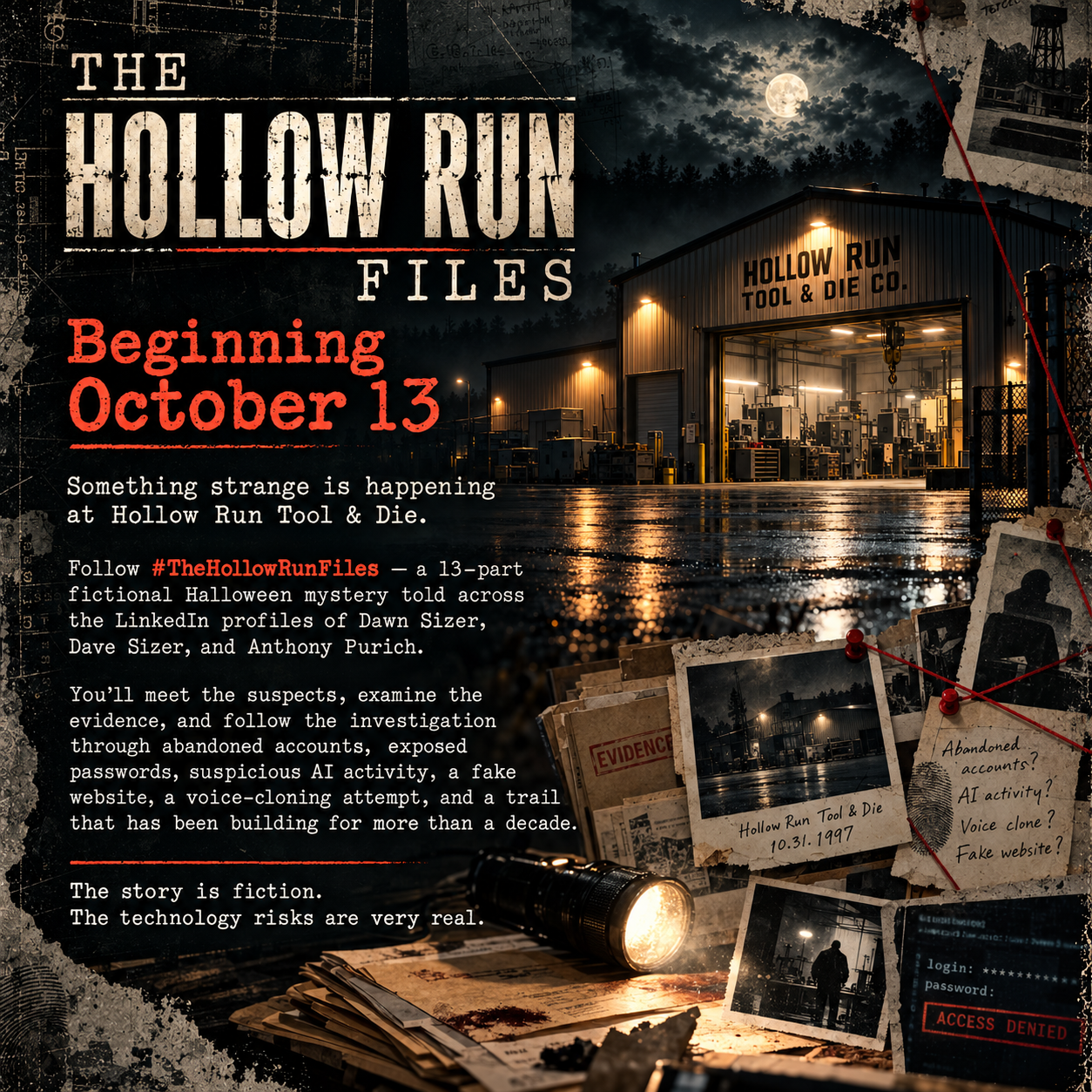
Hollow Run Tool & Die at night, with an evidence board

Something strange is happening at Hollow Run Tool & Die.

Hollow Run is a family-owned manufacturer in a small Pennsylvania town. It has about sixty people, a busy shop floor, a front office that runs on coffee, and a vendor who has brought donuts every month for as long as anyone can remember. The owner has been in business for more than thirty years, and he'll tell you nothing has ever gone wrong.

Then a new IT team starts onboarding. On the very first night, a device that shouldn't exist answers at 3:07 AM.

Beginning October 13, follow #TheHollowRunFiles, a 13-part fictional Halloween mystery told across the LinkedIn profiles of Dawn Sizer, Dave Sizer, and Anthony Purich of 3rd Element Consulting. You'll meet the suspects, examine the evidence, and follow the investigation as the team uncovers abandoned accounts, exposed passwords, suspicious AI activity, a fake website, a voice-cloning attempt, and a trail that has been building for more than a decade.

The story is fiction. The technology risks are very real.

Who's telling the story

Dave Sizer does the digging. He follows the devices, the logins, and the settings, and explains what he finds in plain language.

Anthony Purich works with Hollow Run's people: the CFO, the bookkeeper, the estimator, and the shop floor. He finds out which shortcuts everyone depends on.

Dawn Sizer works with the owner, keeps the suspect board, and is the one who has to tell him what's really going on.

Each of them has a different piece of the story. To see all of it, you'll want to follow all three.

How to play

Every episode on LinkedIn shares one part of the story and one piece of evidence. The same episodes unlock here on the same schedule, with the full, expanded version of each episode.

This is a fair mystery. Everything you need to name the culprit appears in the episodes and the evidence before the reveal. Nothing depends on information you can't see.

Think you know who did it? Submit your guess before 9:00 AM Eastern on Friday, October 30. We want to treat you this Halloween with some free goodies. We'll pick the first few correct guesses and post the winners!

/ Episodes

  1. Episode 1 · Dave Sizer · Tuesday, Oct 13, 9:00 AM ET

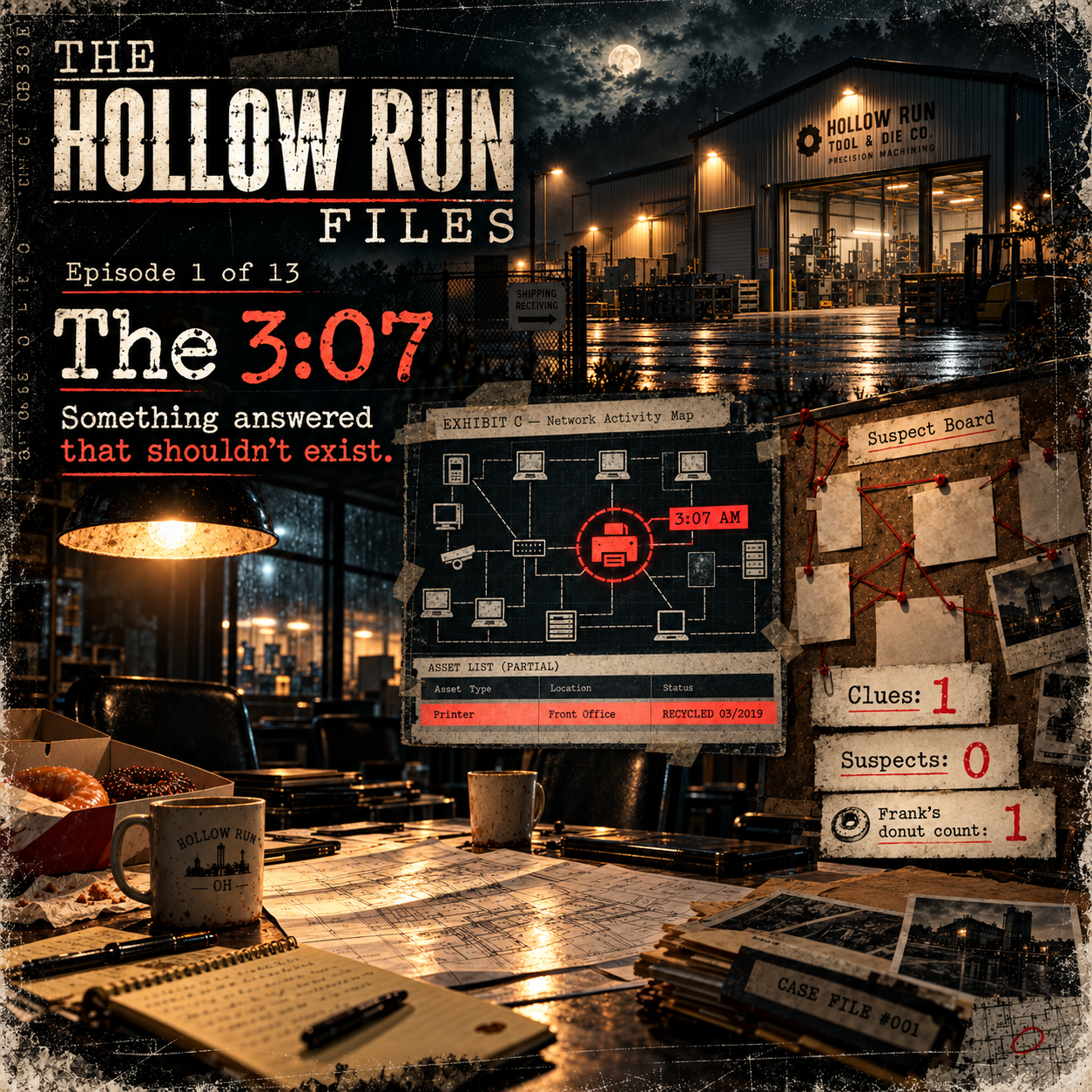
    The 3:07

    A routine network scan at a new client turns up a printer that was thrown out in 2019, still emailing company paperwork every night at 3:07.

    Episode 1 artwork: The 3:07
    Read the full episode

    We started with a new client yesterday. Hollow Run Tool & Die, 60 people, out in Ephrata. Their IT guy, Walt, retired in July after fifteen years, and the owner, Frank, decided it was time for a team instead of a phone number.

    Kickoff was normal. Coffee, a tour of the shop, and a lot of handshakes. Hollow Run is the kind of place where some of the machines are older than the machinists, and every one of them has a nickname. The front office smells like toner and burnt coffee. Frank walked us through all of it like a proud dad.

    Halfway through the tour, a box of donuts showed up on the conference table. They came from Ray, the rep from their fastener supplier, who was in for his monthly visit. Ray has been calling on Hollow Run for eleven years. He knows everyone's name, their kids' names, and where the good coffee is hidden. He shook my hand, told me to call him if we needed anything, and said, "Let's lock it in." I found out later he says that about everything.

    Frank took a donut.

    Last night we did what we always do first with a new client. We ran a scan that makes a list of every device on the network: computers, phones, printers, cameras, the thermostat, the label maker, all of it. You can't take care of something if you don't know it exists, and most companies have more devices than they think.

    The list came back mostly as expected. Sixty-some computers. A couple of servers that should have been retired a few years ago. A smart TV in the break room. Nothing scary.

    At 3:07 in the morning, something answered that shouldn't exist.

    It was a printer, an older office model. I checked it against the equipment spreadsheet Walt left behind. According to Walt's records, that printer was thrown out in 2019. There's even a note next to it: "recycled."

    But it was turned on, connected, and busy. It wasn't printing. It was emailing.

    Every night at 3:07, that printer sends a batch of Hollow Run's paperwork to a strange email address outside the company. It's a free webmail account. It doesn't belong to anyone at Hollow Run or to any vendor I could find. Last night's batch was packing slips, two purchase orders, and a signed drawing from a customer. The printer's history goes back further than I could scroll.

    I sat there looking at that screen for a while. Printers aren't supposed to have opinions about where your paperwork goes.

    This morning I got to Hollow Run before most of the shop and walked the whole building with the floor plan. The front office. Every desk. The conference room. The shop floor, the tool crib, shipping, and the loading dock. I looked behind things and under things. Dale, the shop floor lead, watched me check under a workbench and asked if I'd lost a contact lens.

    No printer anywhere.

    I asked around. Frank didn't know anything about it and figured it was "one of Walt's things." The front office had never heard of it. Nobody remembered seeing that printer in years.

    So here's where we are after day one. Somewhere in that building is a machine that got thrown away seven years ago, and it still goes to work every night at 3:07, sending paperwork to someone who isn't supposed to have it.

    Nobody can tell me where it is.

    Tonight, I'll be awake at 3:07.

  2. Episode 2 · Dawn Sizer · Wednesday, Oct 14, 9:00 AM ET

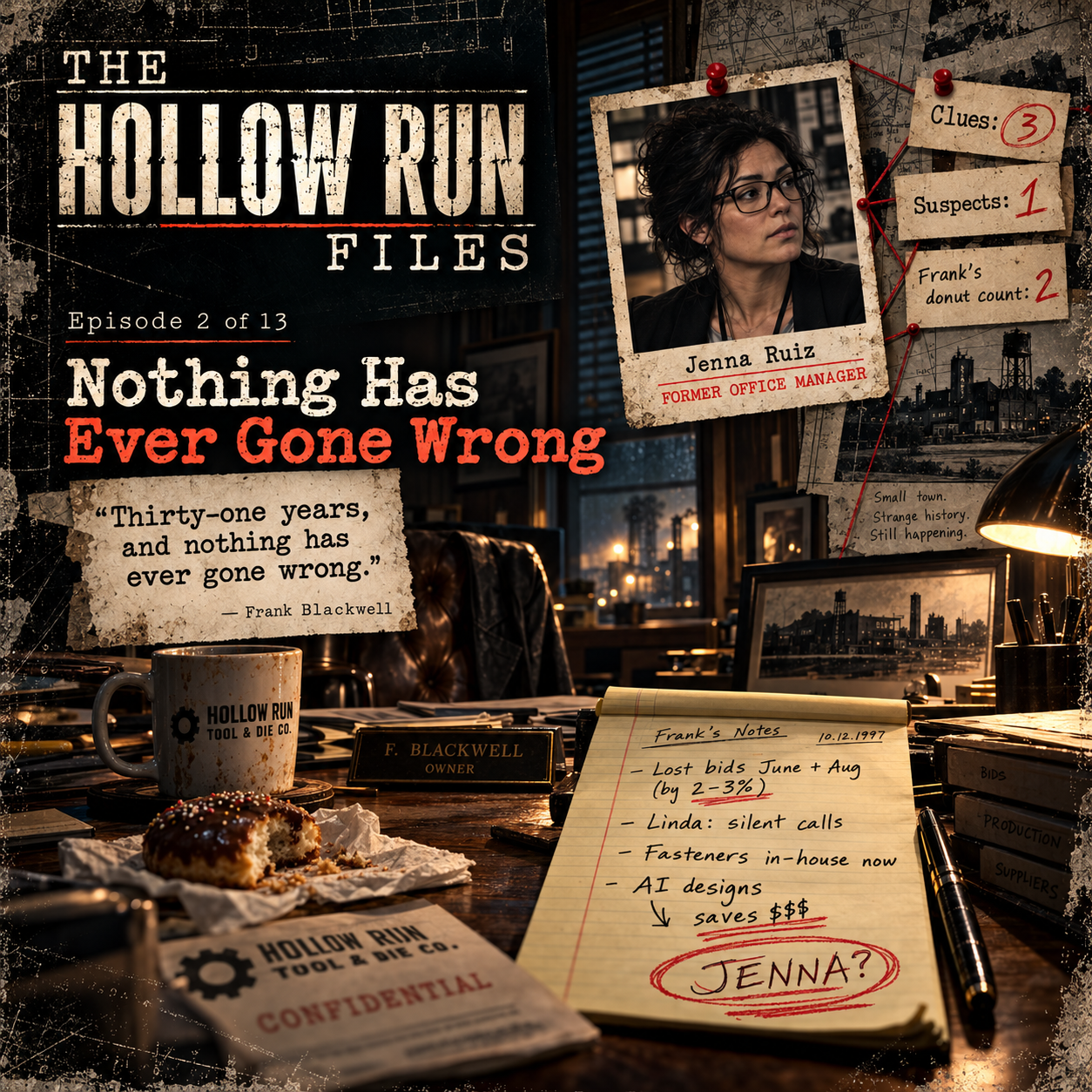
    Nothing Has Ever Gone Wrong

    The owner insists nothing has ever gone wrong, then admits to lost bids, silent phone calls, and a former office manager he is sure is behind it.

    Episode 2 artwork: Nothing Has Ever Gone Wrong
    Read the full episode

    "Thirty-one years," Frank said, "and nothing has ever gone wrong."

    We were in his office, which is half office and half museum. There's a framed photo of his first lathe on the wall, a stack of trade magazines nobody has opened in years, and a calendar from the fastener supplier that's still turned to August. I had just told him about the printer Dave found. He reached for a donut and said it was probably one of Walt's old projects. Walt did everything for fifteen years, and Frank trusts him completely.

    I've heard "nothing has ever gone wrong" in a lot of first meetings. Usually it means nobody has been looking. I didn't say that out loud.

    Then he got quieter. A few things this year hadn't added up.

    Hollow Run lost two big bids over the summer, both by a hair, to a shop none of his customers had heard of. One was a bracket job they had done for the same customer for six years. "Two or three percent under us," he said. "On parts nobody else even makes. I don't know how they did it."

    His CFO, Linda, kept getting phone calls where nobody said anything. A few a week since late summer, always from local-looking numbers. She'd say "Hello? Who is this?" a few times and hang up. Linda figured it was a robocall glitch. Frank figured the same.

    The one thing he was proud of was fasteners. For years Hollow Run bought nearly all its bolts, pins, and custom fasteners from one supplier. About three years ago his team started using AI to help design fasteners they could make on their own machines, and now they buy a fraction of what they used to. He actually got up, walked me out to the shop floor, and handed me a small steel pin fresh off the machine. "Best money we ever saved," he said. "Ray still stops by every month anyway. Good guy."

    Back in his office, he brought up Jenna. She ran the front office from 2017 until August, when she left after an argument about her pay. It hadn't ended well. "She knew every password and every vendor," Frank said. "She set up half the accounts in this building. If somebody's poking around, I'd start with her."

    He said it like he'd already decided.

    I started a suspect board that afternoon. It's a whiteboard in our office, the kind we normally use for project timelines. At the top I wrote HOLLOW RUN. Under it, one name: Jenna. Off to the side, I listed the things that didn't fit anywhere yet: a printer that won't stay thrown away, two lost bids, and a CFO getting calls from nobody.

    Dave walked by, looked at the board, and said, "That's a lot of question marks for day two."

    Frank is sure about Jenna. I'm not sure about anything yet. A printer that's been sending out paperwork for years seems like an awfully long grudge for someone who left in August.

  3. Episode 3 · Anthony Purich · Thursday, Oct 15, 9:00 AM ET

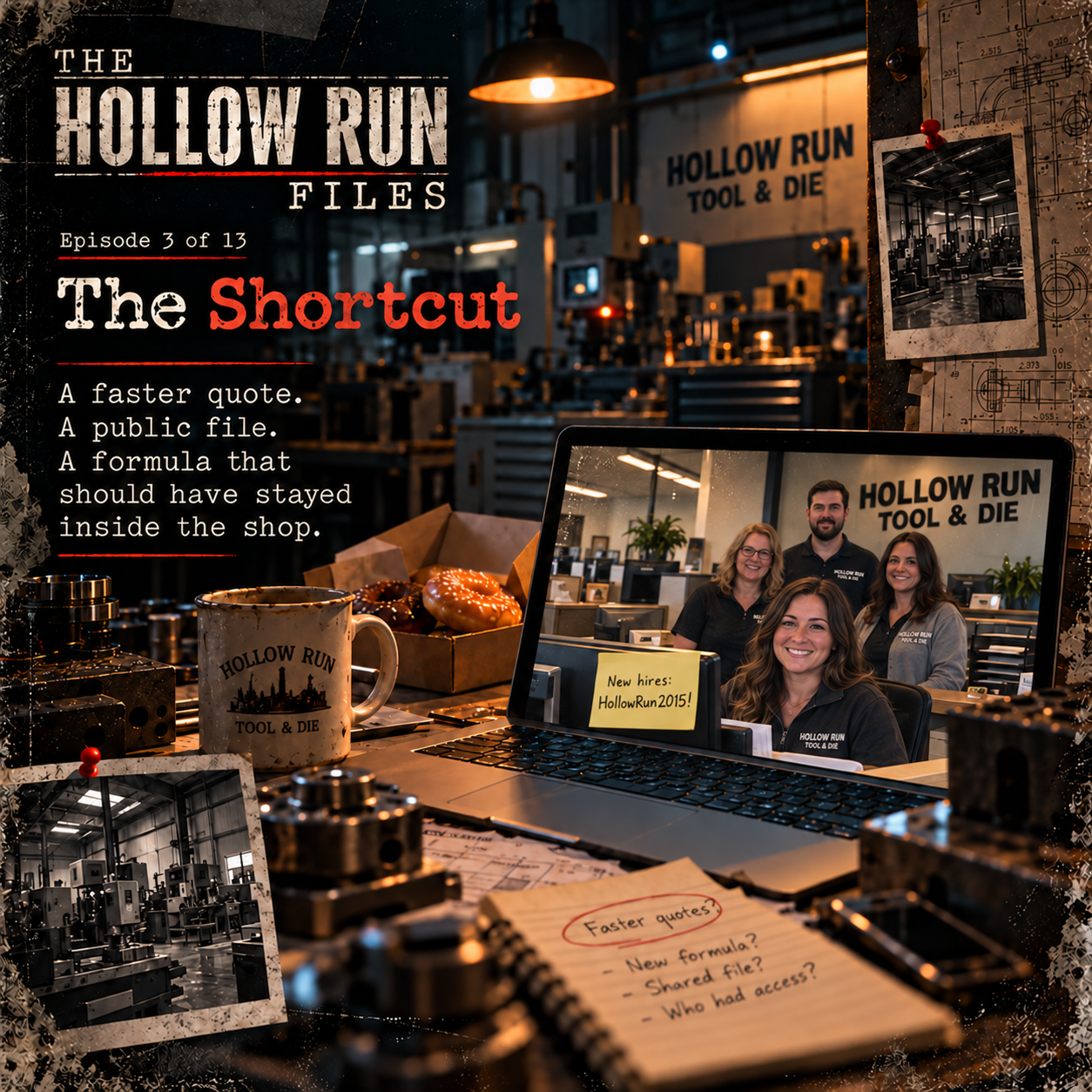
    Meet the Staff

    Anthony meets the people behind the processes, sets a new rule for moving money, and pulls a staff photo from the company website that will matter later.

    Episode 3 artwork: Meet the Staff
    Read the full episode

    My part of onboarding is the people. Before I touch anything, I want to know who does what, what they worry about, and which shortcuts they've come to depend on. That's usually where the real risk is. Most technology problems start out as somebody's workaround.

    I spent most of the day walking desk to desk with a notebook. Hollow Run has the kind of team that has worked together long enough to finish each other's sentences, and to cover for each other's habits.

    Linda, the CFO, runs the money and has been on the same weekly call with their fastener supplier for eleven years, same time every week, like clockwork. She mentioned the silent phone calls again and laughed it off. "Either I have a secret admirer or a very broken robocall," she said.

    Tasha, the bookkeeper, sends the payments: wires, vendor checks, payroll. She has been doing it for twelve years and has never made a mistake, which she told me twice. I set up a policy with her and Linda that day. Any request to move money, from anyone, by any channel, gets a call back to a number already on file and a code word only the three of us know. Even if the request comes from Frank. Even if it sounds exactly like Linda.

    Tasha rolled her eyes. "We've never had a problem." Linda wrote the word on a card and put it in her wallet.

    Marcus, the estimator, has cut quote turnaround from four days to one this year. Customers love him, and Frank calls him "the magician." When I asked how, he grinned and said, "It's this AI thing. It's amazing." He started to pull it up on his screen, then got called away to the phone. I wrote it down and underlined it.

    Dale, the shop floor lead, listened to my whole speech about security and said, "So, no more passwords on sticky notes?" Then he went back to work. I still can't tell if he was joking.

    At the end of the day I had three lines circled in my notes: Linda's silent calls, Marcus's AI tool, and the new code word. None of them looked like a problem yet. They looked like a normal Tuesday at a busy company.

    To get everyone's titles right for our records, I pulled the staff photo from Hollow Run's website. It's the front office, taken in 2022. Jenna is smiling at the front desk with a headset on. Behind her, a monitor has a yellow sticky note stuck to the bottom edge. On the counter beside her sits an open box of donuts. The photo is still up on the "Meet the Team" page, where anyone can see it.

    I didn't think anything of the photo until later.

  4. Episode 4 · Dave Sizer · Monday, Oct 19, 9:00 AM ET

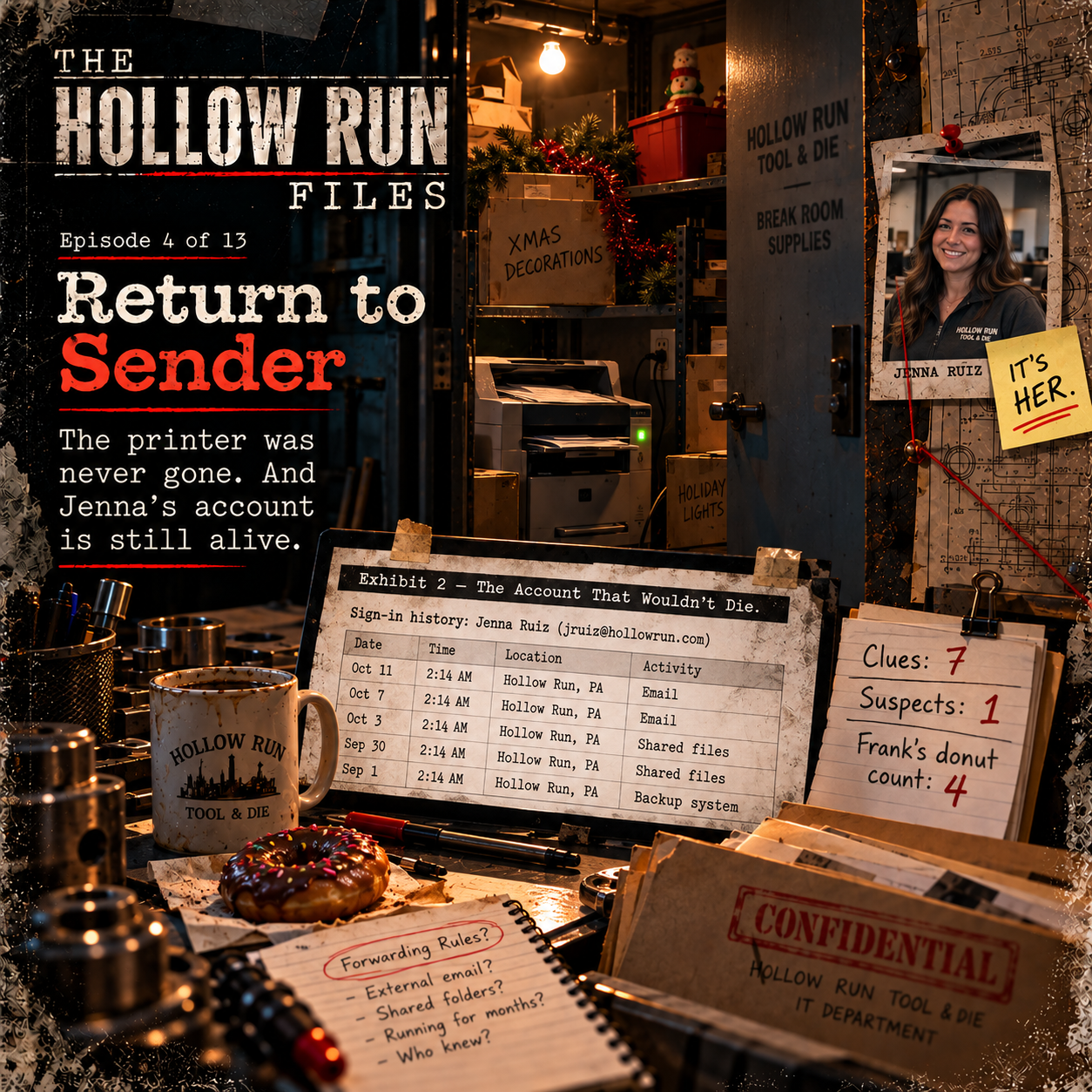
    Return to Sender

    Dave finds the printer hidden in a closet, learns how long it has been sending paperwork out the door, and discovers a former employee's account that someone is still using.

    Episode 4 artwork: Return to Sender
    Read the full episode

    Every device plugs into something. Wi-Fi or a cable, it has to connect somewhere, and the network keeps track of where. So instead of searching the building again, I followed the printer backward through the network, one connection at a time. It led to a supply closet behind the break room.

    The closet hadn't been opened in years. The door stuck, and inside it smelled like dust and old cardboard. Behind three boxes of Christmas decorations (one labeled "OFFICE PARTY 2018, DO NOT TOSS"), the printer sat plugged into the wall with a little green light blinking, like it had been waiting for someone.

    Dale wandered over, looked at it for a second, and said, "Huh. I wondered where that went."

    Here's what it was doing. The copier at the front desk had been set up to quietly send a copy of every scan to this printer. Nobody at the front desk would ever notice, because the copier still did its normal job. But every night at 3:07, the printer forwarded the whole pile to an outside email address. Purchase orders, packing slips, customer drawings, signed quotes. Anything that crossed the front desk scanner went out the door too.

    I checked when that setting was created: March 2015. That's eleven years of Hollow Run's paperwork.

    We unplugged it, took pictures, and put it in an evidence bag. Then I set an alert to tell us if anything tried to reach it.

    At 3:07 the next morning, my phone buzzed. Someone outside the building was trying to reach the printer. Eleven tries in four minutes, then nothing. Whoever is on the other end noticed it was gone, and they noticed fast.

    Then we ran the next onboarding step: checking every account that belongs to someone who no longer works there. Most companies have a few of these. Hollow Run had one.

    Jenna's account is still active. Her password hasn't changed since 2019. MFA, the second step where your phone confirms it's really you, was never turned on. Anyone with her password could walk right in.

    And someone has been.

    Here is her sign-in history since she left on August 22:

    September 1, 2:14 AM, from Lancaster, the backup system

    September 30, 2:14 AM, from Lancaster, shared files

    October 3, 2:14 AM, from Lancaster, shared files

    October 7, 2:14 AM, from Lancaster, email

    October 11, 2:14 AM, from Lancaster, email

    Same minute. Same town. Every time, while the building is empty.

    I called Dawn. She wrote "2:14" on the board next to Jenna's name and underlined it twice. When Frank heard, he didn't say anything. He just took another donut.

  5. Episode 5 · Anthony Purich · Tuesday, Oct 20, 9:00 AM ET

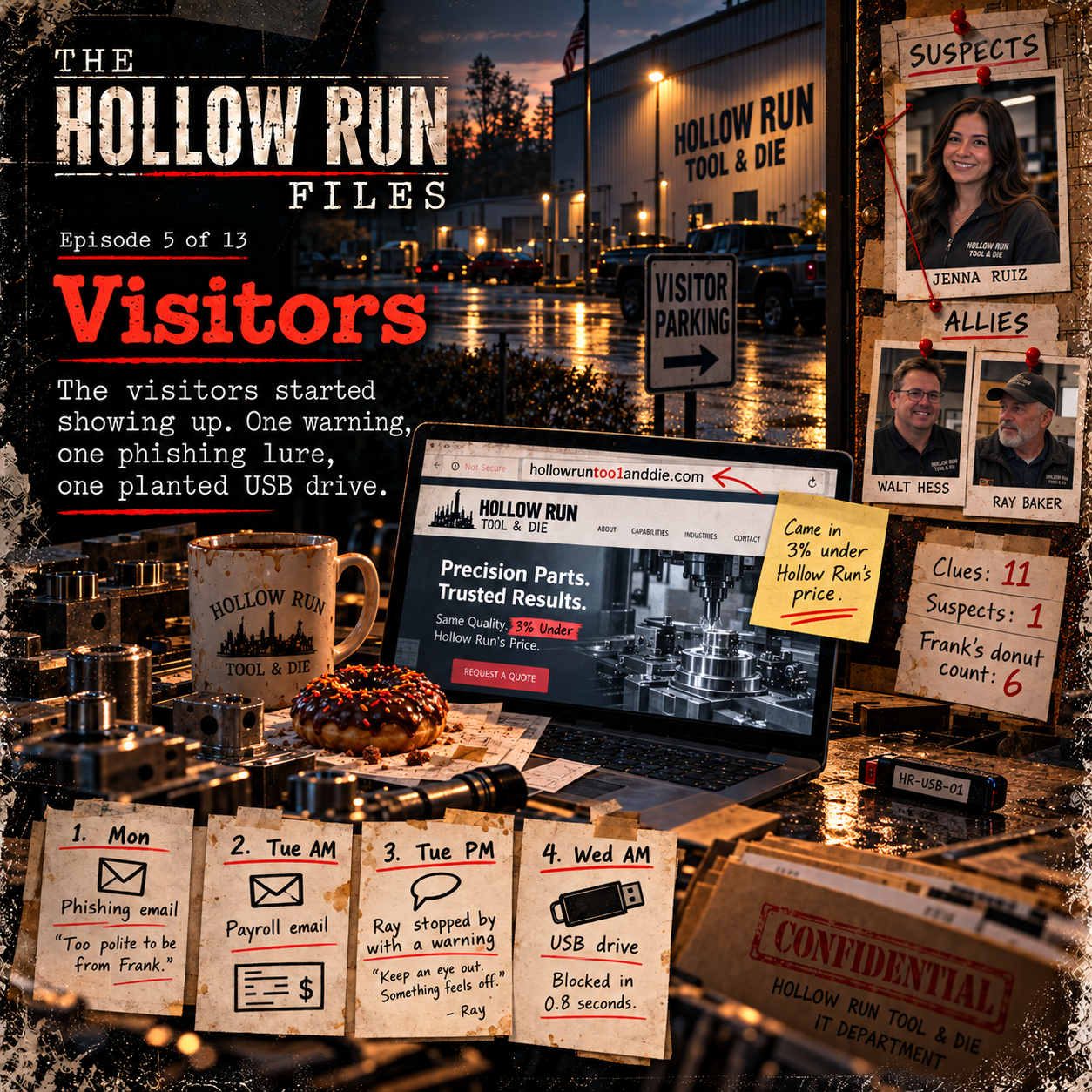
    Visitors

    Phishing emails that know too much, a fake Hollow Run website, a worried visit from a longtime vendor, and a USB drive in the parking lot.

    Episode 5 artwork: Visitors
    Read the full episode

    Once people at Hollow Run knew who to call, the calls started coming in to our tech team. Most of them were the usual first-week things: a printer driver here, a password reset there. A few of them were not.

    Monday. Dale forwarded an email from "Hollow Run Scheduling" about a new ship date for Job 4471. It had the right job number, the right customer, and the right date. It even had the little blue logo from the bottom of their real emails. The link went to a fake Microsoft login page built to collect his password. Dale didn't click it. "Too polite to be from Frank," he said.

    Tuesday morning. Another email, to Tasha this time. It mentioned Frank's daughter by name and said she'd been added to payroll and needed approval before Friday. Tasha didn't approve anything. She forwarded it to us with one word: "Nope." Whoever is writing these knows things about Hollow Run that outsiders shouldn't know.

    Tuesday afternoon. Ray from the fastener supplier showed up unannounced, with a box of donuts and a worried look. One of his other customers had received a quote from a website pretending to be Hollow Run, and he wanted Frank to know right away. He showed us on his phone. The site looked exactly like Hollow Run's, logo and staff photos and all. The only difference was the web address. Where the real one spells "tool" with two o's, the fake one used two zeros.

    "Somebody's out to get you, Frank," Ray said. "We'll figure it out. Let's lock it in." Frank was touched. He ate a donut.

    Wednesday morning. A machinist found a USB drive in the visitor parking spaces by the front door. It was labeled 2026 BONUS LIST, CONFIDENTIAL. He plugged it into a shop computer to find out whose it was (and what his bonus was). Anyone would.

    The drive tried to install something that would let an outsider take control of the computer from anywhere. The security software we installed in week one blocked it in under a second and sent us an alert. I walked out to the shop to talk with him. He was mortified. I told him the truth: the people who make those drives are counting on curiosity, and they usually win. A month ago, nothing on that computer would have stopped it.

    That night I made a list of everyone who could know Hollow Run's job numbers, Frank's daughter's name, what the website looks like, and where visitors park. Employees, former employees, customers, vendors, delivery drivers, anyone who has ever sat in the lobby.

    It was a long list.

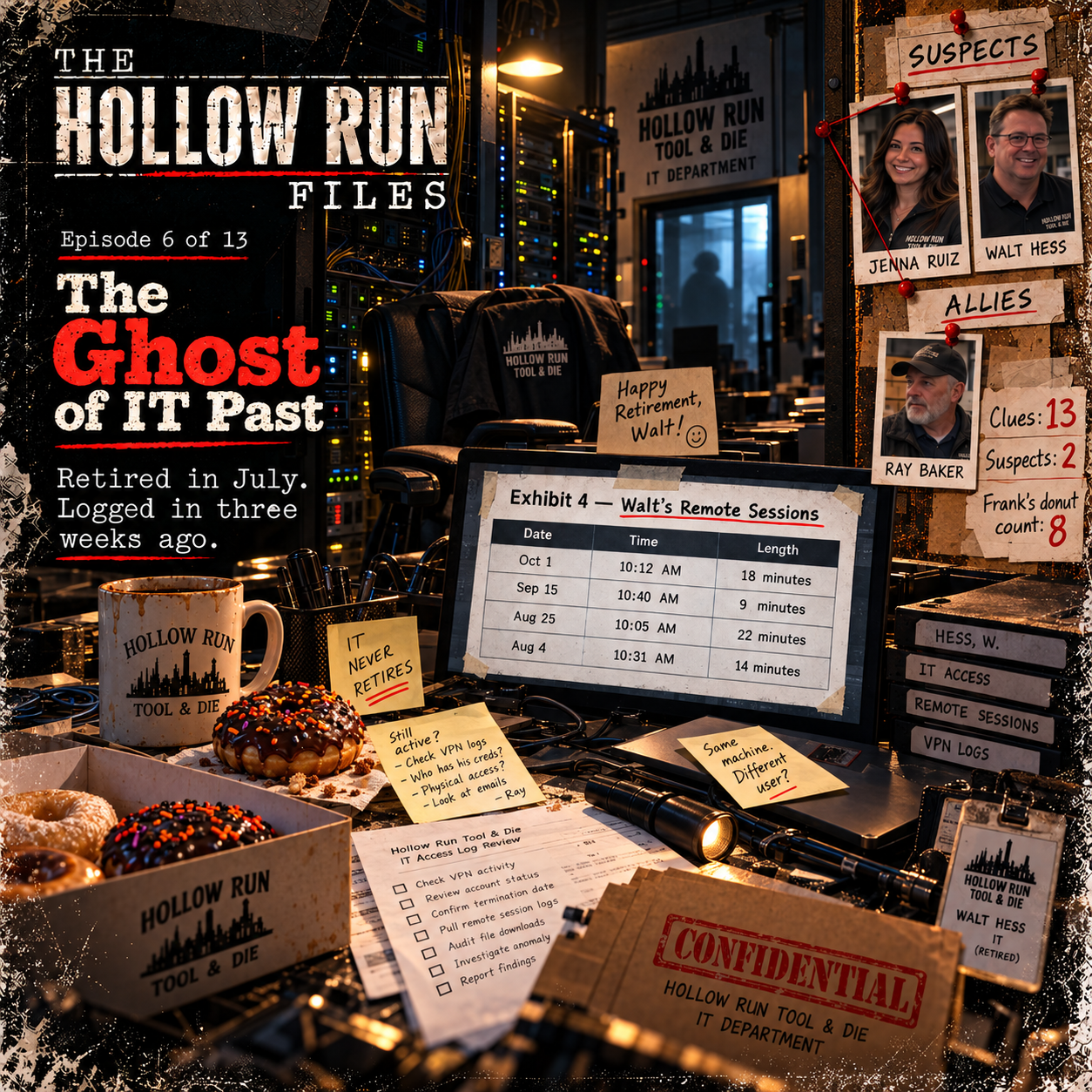
  6. Episode 6 · Dawn Sizer · Wednesday, Oct 21, 9:00 AM ET

    The Ghost of IT Past

    Dave finds a remote control program registered to Hollow Run's retired IT guy, still in use months after he left, and a second name goes on the suspect board.

    Episode 6 artwork: The Ghost of IT Past
    Read the full episode

    Dave called me at 7 AM from Hollow Run's site with some strange news. Dave doesn't call at 7 AM. Dave texts at 7 AM, if he has to. So I knew before he said a word that it wasn't good.

    On one of Hollow Run's PCs, the one at the front desk next to the scanner, he'd found a remote control program. It's the kind of tool that lets someone run a computer from anywhere in the world, as if they were sitting right in the chair. It was registered to Walt. Walt retired in July, and the program was used three weeks ago.

    Walt's main account was secure. Somebody had at least shut that door when he left. But Dave went back through fifteen years of settings, and he kept finding Walt's name. Walt was there in 2015 when the printer started sending paperwork out the door. Walt approved access for outside programs that Dave is still working through. Walt set up the backups. Walt picked the passwords. For fifteen years, if something touched a computer at Hollow Run, Walt had his hands on it.

    None of that is unusual for a company that has one IT person for a long time. It's how small businesses work. It also means that when something goes wrong, every road leads back to the same person.

    I drove out to tell Frank in person. That isn't the kind of news you give someone over the phone.

    He listened without interrupting. Then he was quiet for a long time, looking at a framed photo on his shelf from his daughter's wedding. "Walt was at my daughter's wedding," he said finally. "He danced with my mother." Then he ate two donuts without saying anything.

    That afternoon I added a second name to the suspect board, right under Jenna's. Dave stood next to me while I wrote it. Neither of us said anything for a minute.

    Frank still thinks it's Jenna. Now I have to admit it might not be.

    One thing bothers me, and I'll leave it here for anyone keeping score. The remote program keeps a log of every time it's used. Here is every session since Walt retired:

    August 4, 10:31 AM, 14 minutes

    August 25, 10:05 AM, 22 minutes

    September 15, 10:40 AM, 9 minutes

    October 1, 10:12 AM, 18 minutes

    Take a look at when Walt actually logged in.

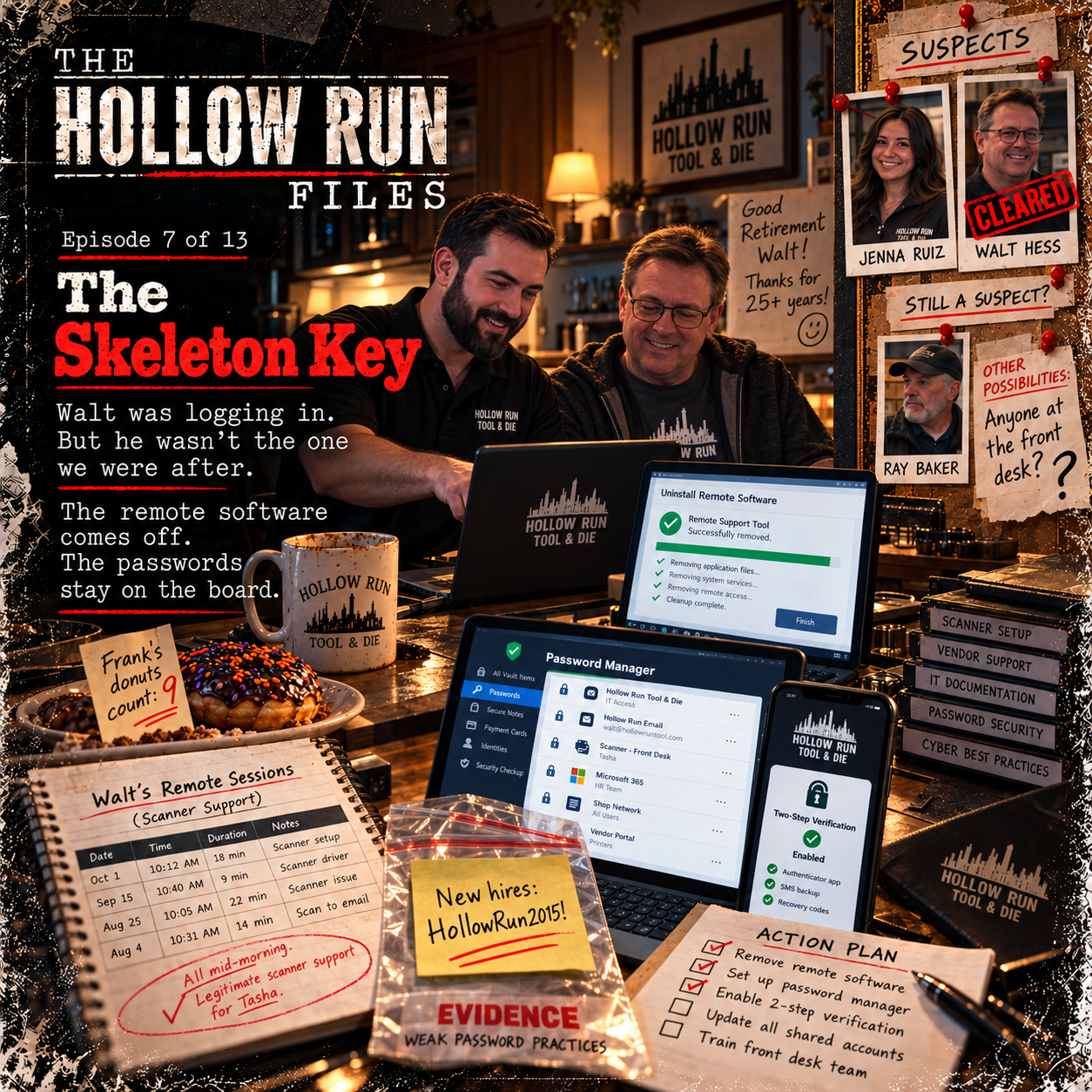
  7. Episode 7 · Dave Sizer · Thursday, Oct 22, 9:00 AM ET

    The Skeleton Key

    Dave visits Walt, clears him, and finds the password on the front desk sticky note still unlocking nearly half the accounts at Hollow Run.

    Episode 7 artwork: The Skeleton Key
    Read the full episode

    I went to see Walt at his house. He lives about ten minutes from the shop, in a ranch house with a garage full of old computers he says he's "going to get around to." He made coffee in a mug from a 2009 trade show, and we sat at his kitchen table. When I showed him the remote program, he turned red.

    Tasha had been calling him whenever the front desk scanner jammed, and he'd been fixing it from home as a favor. He didn't want to bother Frank, and he didn't think anybody would mind. Tasha confirmed it when I called her. Every session was mid-morning, right when the scanner gets busiest. Walt is in bed by nine, and none of his logins were anywhere near 2:14 AM. We removed the program together, right there at his table, and he apologized about six times.

    Then I asked him about the printer setting from 2015. He shook his head slowly. "A vendor's guy set that up. Said his company did it for all their customers so purchase orders got to them faster. I couldn't tell you whose. We had a lot of vendors in and out back then."

    Then I asked about the sticky note on the front desk PC, the one you can see in the staff photo. "I picked that password in 2015 for new hires," he said. "Jenna stuck the note up so people could find it. They were supposed to change it on the first day." He paused. "I guess I never checked that they did."

    So I checked. The note says New hires: HollowRun2015! and 23 of Hollow Run's 60 accounts still use that exact password. None of them needed MFA until a few weeks ago, when we took over. The same password also turned up in a 2019 data breach of an online shopping site, because someone at Hollow Run reused it at home. Anyone who bought that breach list had it too.

    That note sat on the front desk for years, where every visitor and employee could read it. Then it went on the company website, where anybody in the world could zoom in. From then on, it worked like a skeleton key.

    That afternoon everyone at Hollow Run got a password manager, which is an app that creates and remembers a different strong password for every account, so nobody has to write anything down. Every login now needs MFA from their phone. The sticky note is in an evidence bag next to the printer. Frank picked up the bag, read the note, set it back down, and took a donut.

    Walt is off the board. Jenna is still on it. And now I have to add everyone who ever stood at that desk or looked at the website as a suspect.

    That's a lot of people. Some of them have been coming in for years.

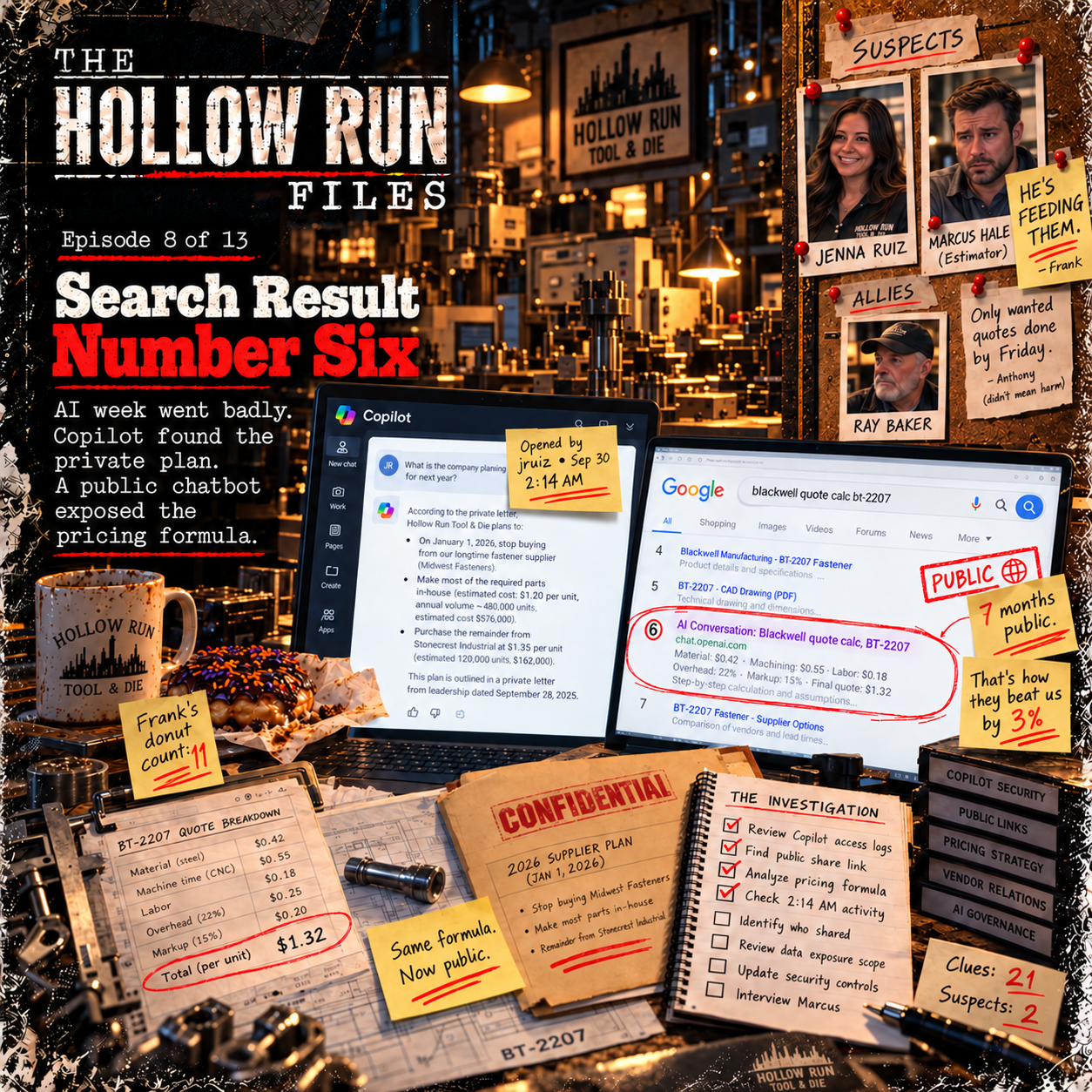
  8. Episode 8 · Anthony Purich · Monday, Oct 26, 9:00 AM ET

    Search Result Number Six

    AI week at Hollow Run: Copilot hands a clerk the owner's private plans, and a Google search turns up the company's entire pricing formula in a public AI chat.

    Episode 8 artwork: Search Result Number Six
    Read the full episode

    This was AI week at Hollow Run Tool & Die, and it went badly.

    Walt had turned on Microsoft Copilot for five people last spring. Copilot is the AI assistant built into Microsoft 365. You ask it a question, and it searches everything you have access to (email, documents, shared folders) and writes you an answer. That's what makes it useful. It's also what makes it risky, because it's very good at finding things people forgot were there.

    So before anyone keeps using it, we check what it will hand to an ordinary employee. I logged in as a test account with the same access as a front office clerk and typed one question: What is the company planning for next year?

    In four seconds, Copilot summarized a private letter Frank had written in August. On January 1, Hollow Run stops buying from its longtime fastener supplier for good. It will make almost everything in-house and buy the little that's left from Stonecrest Industrial. The letter included dollar amounts, the date Frank planned to tell the supplier, and a line about how much the switch would save.

    Copilot didn't break in anywhere. Frank had saved the letter in a folder the whole company could open, years ago, back when it was the only shared folder they had. Copilot simply found it, the same way any curious employee could have.

    Frank went pale when I showed him. We locked the folder down that afternoon.

    Then I checked who else had opened the letter. Jenna's account did, on September 30, at 2:14 AM.

    Next came the check I'd written down on day one: Marcus's "AI thing."

    I searched Google for Hollow Run Tool & Die. Result number six was a conversation from a free AI chatbot, shared publicly, titled Hollow Run quote calc, BT-2207. It contained Hollow Run's material costs, machine rates, markup, and a step-by-step formula for pricing any job. Anyone who clicked it could quote like Hollow Run.

    Marcus had pasted it all in to save time. He clicked "Share" to send it to Dale and emailed him the link in March. Nobody had ever told him the link was public. When I asked Dale about it, he shrugged. "Never opened it. Marcus's emails are all spreadsheets."

    Frank put Marcus on the suspect board himself. "That's how the competitor beat us by 3%," he said. "He's feeding them." Then he ate a donut like it had personally offended him.

    I sat with Marcus afterward in the break room. He was pale and kept saying he only wanted to get quotes out by Friday. I believe him. He used the only tool he had, and nobody gave him a better one or a rule to follow. We took the shared link down before we left that day. Getting him a safe tool and a clear policy went to the top of our list.

    But his formula was on Google for seven months. Anyone could have found it. Someone did.

  9. Episode 9 · Dawn Sizer · Tuesday, Oct 27, 9:00 AM ET

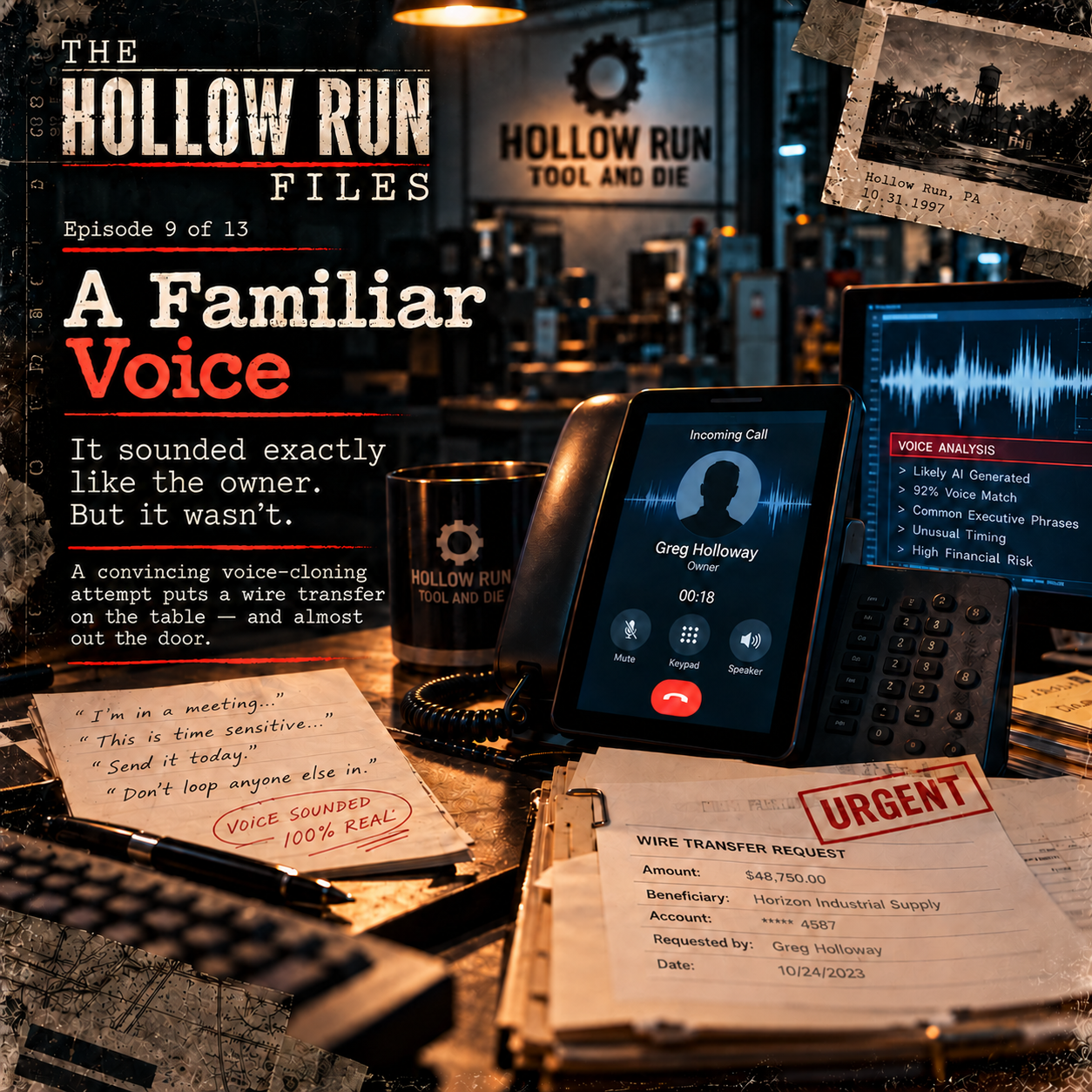
    The Voice on the Line

    The bookkeeper gets a call from the CFO asking for an urgent $186,400 wire. It sounds exactly like her. It isn't.

    Episode 9 artwork: The Voice on the Line
    Read the full episode

    I had to have another chat with Frank today, after a panicked call from Tasha.

    I could tell something was wrong the second I picked up. Tasha is the calmest person at Hollow Run. She has sent payroll through a snowstorm and a power outage. Today she was talking so fast I had to ask her to start over.

    Here's what happened.

    At 2:40 PM Tasha's phone rang, and the caller ID said Linda.

    It was Linda's voice, a little rushed, the way she sounds at the end of the month. Frank had approved an early payment to Stonecrest, the new supplier, to hold January pricing: $186,400. The bank details would come by email in five minutes. Frank was in with a customer and couldn't be bothered. "Just get it out today. Let's lock it in."

    The email arrived four minutes later, with Stonecrest's logo, an invoice that looked exactly right, and Linda's signature at the bottom. Later, when we looked closely, the sender's address was off by a little. Where "tool" should have two o's, it had two zeros. Tasha didn't catch it in the moment. Almost nobody would.

    Tasha told me afterward that she almost sent it. The voice was right. The supplier was right, and almost nobody outside Frank's office knew about Stonecrest. The amount was big, but not crazy for a supplier change. But something nagged at her. "Linda never talks like that," she said. "Lock it in?"

    So she did the thing she'd rolled her eyes at two weeks earlier. "Sure, Linda. What's the word?"

    The line went quiet for two full seconds. Then the voice laughed, Linda's laugh, and said, "Tasha, come on. It's me."

    Tasha hung up and called Linda's cell from the number on file. Linda picked up in her car on the turnpike. She hadn't called anyone all afternoon.

    Here's the part that's hard for people to believe. Today's AI tools can copy someone's voice from a few minutes of recordings. The tone, the pace, the laugh, all of it. The caller ID was faked too, which is easy to do.

    That's what the silent calls were for. Every "Hello? Who is this?" was a recording. Someone had been collecting Linda's voice for weeks, and they had plenty to work with from somewhere else too.

    I sat down with Frank in his office afterward. He listened, then reached for the donut box on the corner of his desk. It was empty. He stared at it for a while.

    Then he pulled up the photo of our suspect board I'd texted him that morning. "It's Jenna," he said. "It has to be."

    I didn't argue. But I had heard someone say "Let's lock it in" before, and I couldn't remember where.

  10. Episode 10 · Dave Sizer · Wednesday, Oct 28, 9:00 AM ET

    The Attic

    Dave finds a forgotten app that has been reading every email at Hollow Run, then runs a restore test and learns the backups have been empty for five years.

    Episode 10 artwork: The Attic
    Read the full episode

    Every Microsoft 365 account has an attic. It's the list of outside programs someone once clicked "Accept" for, and most companies never look at it, ever. Calendar tools, PDF converters, shipping plugins. Each one got a key to something on the day it was approved, and most of them still have it.

    Hollow Run's attic had 31 programs. Thirty were harmless. A few hadn't been used since 2020, so we cleaned those out too.

    The last one was called RFS Order Portal, approved by Walt in 2021. It had permission to read every email in the company, every mailbox, all the time, with no one logged in. No password needed. No second step. Just a standing invitation.

    Frank remembered it. "That was the old online ordering thing. The supplier stopped using it a few years ago. Their guy said he'd take care of it."

    Nobody took care of it. The small software company that built it went out of business in 2023. In 2024, someone bought its old web address and hid their name. Since then, whoever owns that address has been able to read every email at Hollow Run. That includes Frank's letter about switching suppliers, and Dale's email from March with the link to Marcus's AI chat.

    Revoking it took eleven seconds. It had been sitting there for five years.

    Marcus is off the board. Whoever was reading the attic had his formula the day he sent it.

    That left one onboarding test, which is restoring a file from backup. We never trust a backup until we've pulled something out of it.

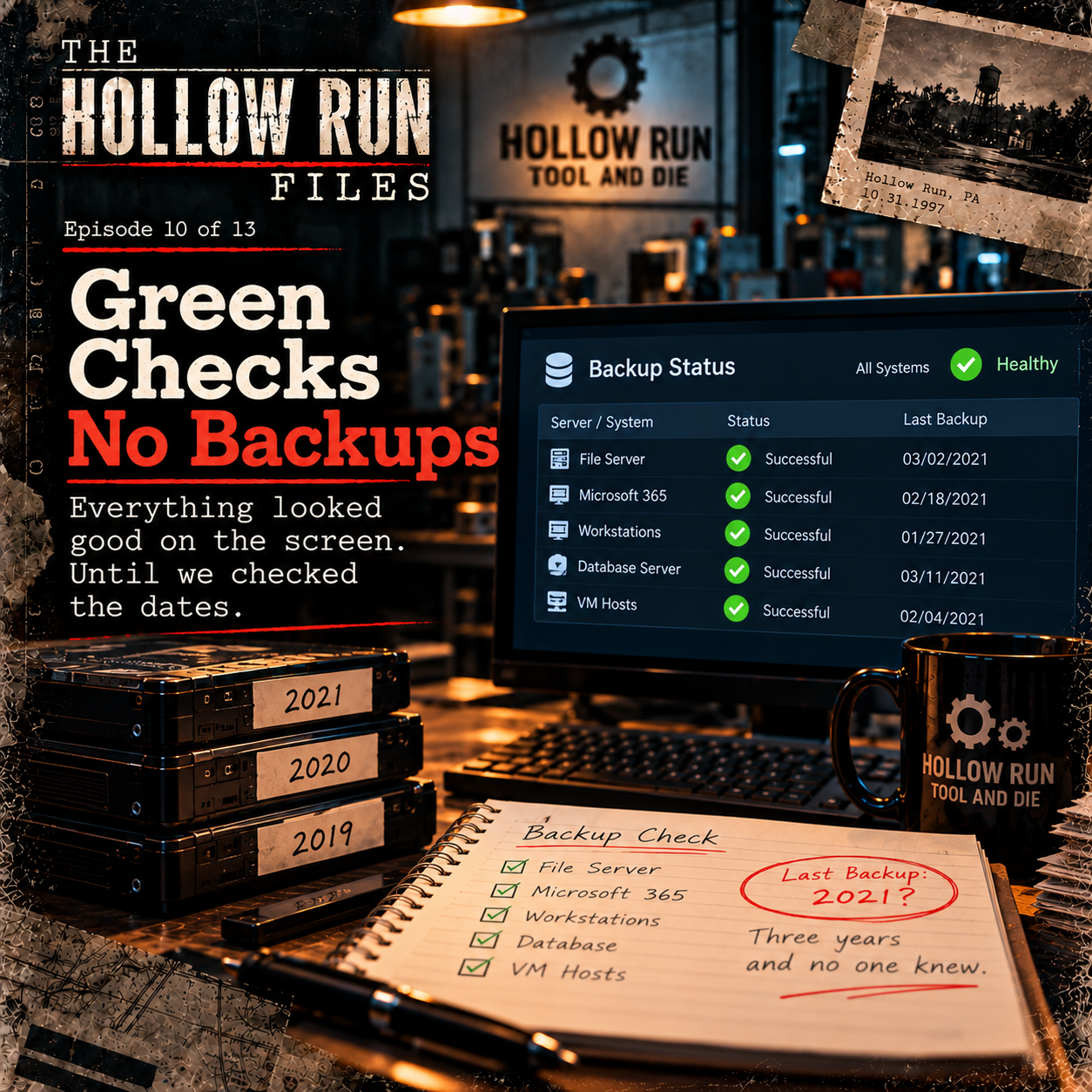
    Hollow Run's backup screen looked perfect: more than 1,800 green checkmarks in a row, one for every night. I restored last week's copy of Marcus's quote folder. The restore finished in two seconds, which is way too fast. The folder was empty.

    I went back a month. Empty. A year. Empty. I kept going until I found real files. The last good backup was August 31, 2021.

    On September 1 at 2:14 AM that year, Jenna's account logged into the backup system and told it to back up nothing. A backup of nothing never fails, so the checkmarks stayed green for five years. Nobody ever tested a restore, so nobody ever knew.

    And remember that September 1 login in Jenna's history from Episode 4? Same account, same system, same minute, five years to the day. Someone was checking that the backups were still off.

    Frank didn't reach for a donut this time. He just sat there.

    We made a full backup that afternoon, saved a copy somewhere nobody can delete or change, and restored a test file to prove it worked.

    People don't stop backups for fun. They do it when they're planning something big and don't want you to be able to recover from it. Whoever did this started planning a long time ago.

    One name is left on the board, and Halloween is almost here.

  11. Episode 11 · Anthony Purich · Thursday, Oct 29, 9:00 AM ET

    Cleared

    The team reaches Jenna, clears her, and follows every clue back to a single email address.

    Episode 11 artwork: Cleared
    Read the full episode

    We reached Jenna on a video call last night. It was 1 AM where she is, and she answered anyway.

    She has lived in Lisbon since September 5 and teaches English to kids. She sent her boarding pass and her lease before we finished asking. When we told her what had been done with her account, she covered her mouth and didn't speak for a while. When she did, the first thing she asked was whether Tasha was okay.

    Every 2:14 AM login came from Lancaster. Jenna was 3,500 miles away. And Hollow Run hired her in 2017, two years after someone set up the printer to send paperwork out the door.

    That still left the backups. They were turned off with her account in September 2021, while she still worked at Hollow Run. So we asked her about it. She was quiet for a second, then said she'd never changed her password. Not once. It was the one from the sticky note, the same one Walt gave every new hire in 2015.

    "Everybody saw that note," she said. "Customers. Delivery drivers. Vendors. I used to tell people not to read it out loud."

    So her account didn't belong to her in any way that mattered. It belonged to anyone who had ever stood at that front desk. At 2:14 AM in September 2021, Jenna was asleep at home like everyone else. Someone else was using her name.

    Jenna didn't do this. Her account was a door somebody left unlocked, long before she walked out.

    So who walked through it? Every clue points back to the same place.

    The printer was sending Hollow Run's paperwork to an outside email address. When the fake website was registered on September 2, the service that hides the owner's name didn't kick in for 40 minutes. Sites that track domain history saved the owner's email during that window. It was the same address.

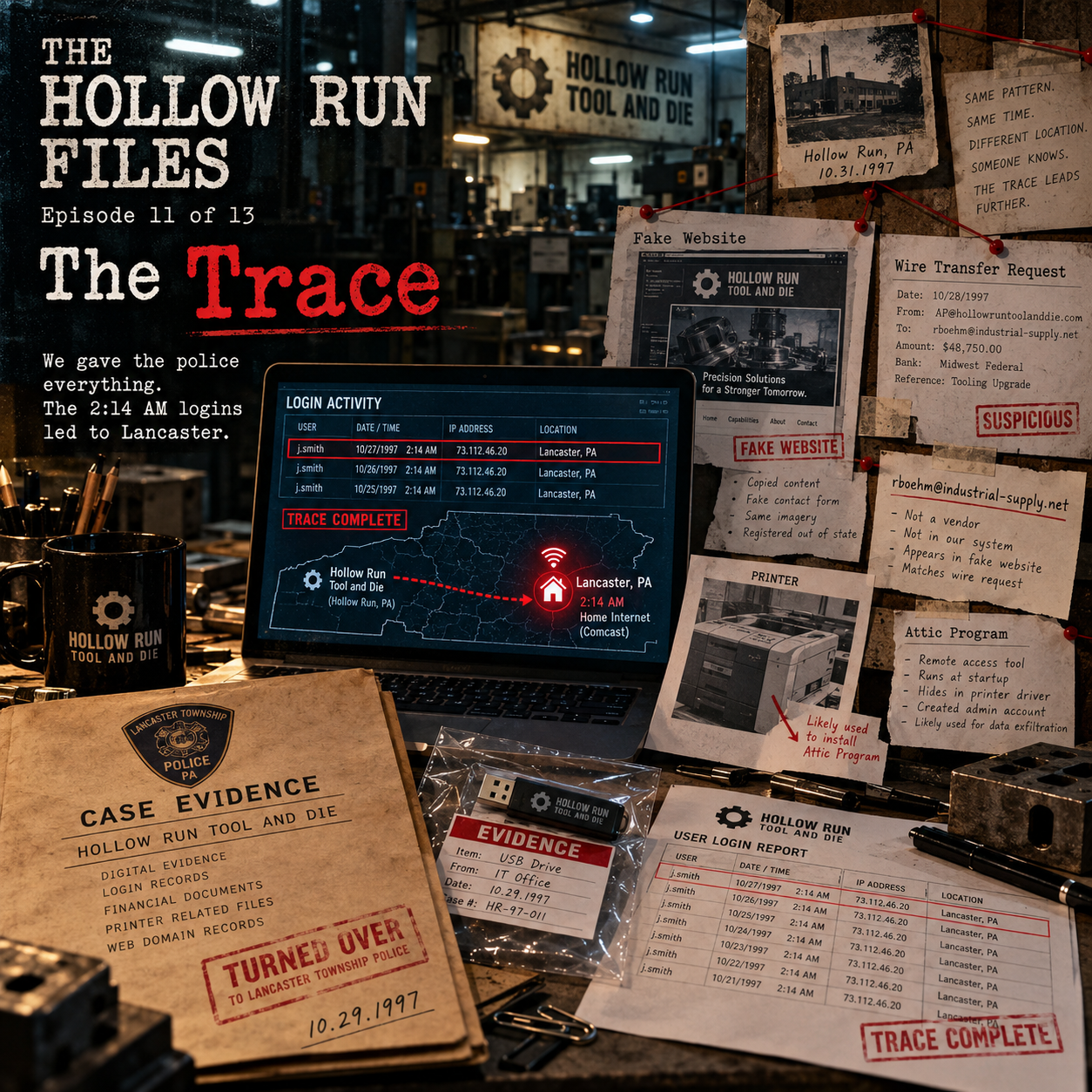
    We gave all of it to the police: the printer, the logins, the attic program, the USB drive, the fake website, the wire request, and that email address. They traced the 2:14 AM logins to a home internet connection in Lancaster, and the rest followed from there.

    Frank called me after I told him. He was quiet, then said, "I owe Jenna an apology." He's right. He's going to call her himself.

    If you want to beat the reveal, go back to Episode 1. Look at who has been coming by Hollow Run since 2015.

    Only one episode left...

  12. Episode 12 · Dawn Sizer · Friday, Oct 30, 9:00 AM ET

    Pumpkin Donuts

    The unmasking.

    Episode 12 artwork: Pumpkin Donuts
    Read the full episode

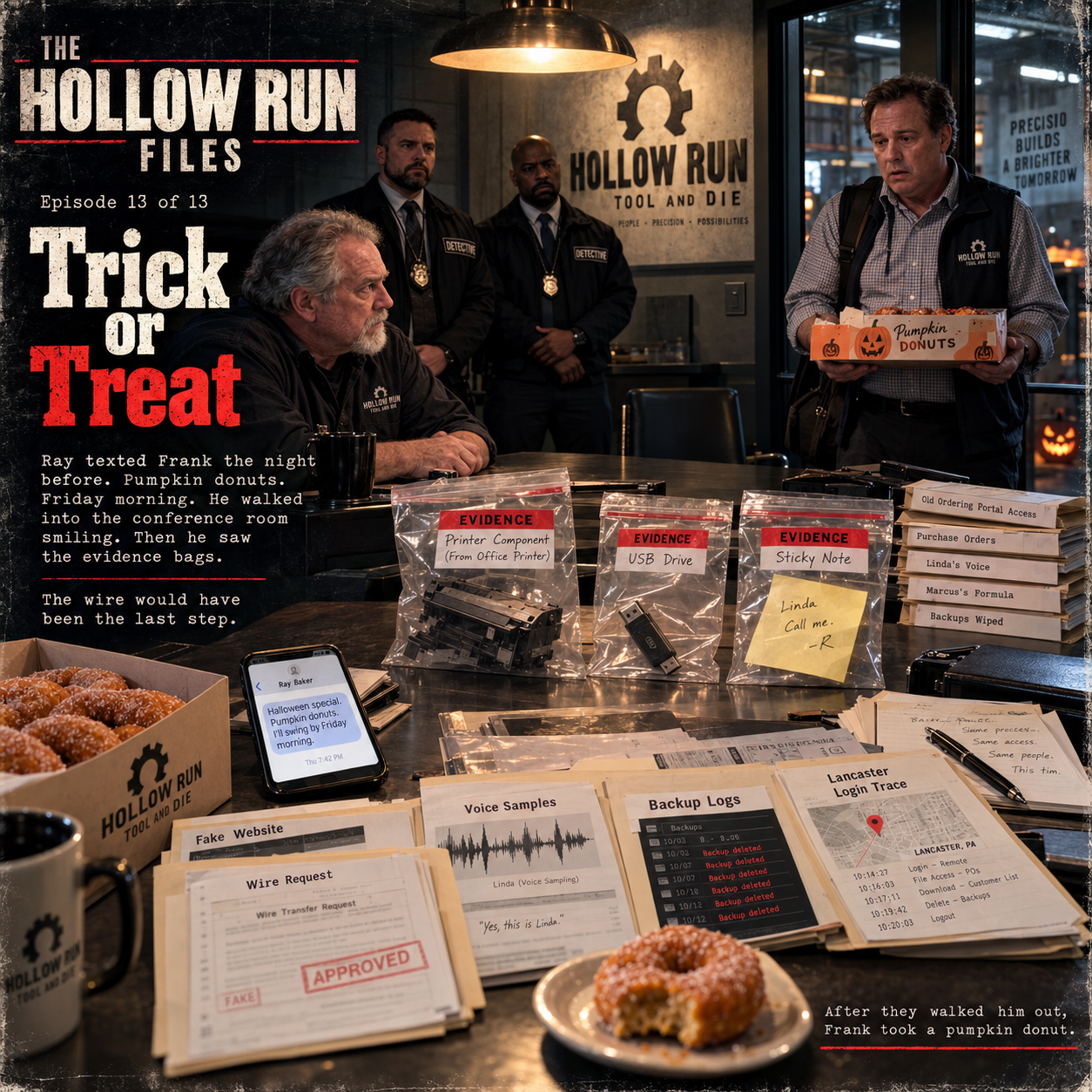
    Ray texted Frank last night. "Halloween special. Pumpkin donuts. I'll swing by in the morning."

    Frank was waiting in the conference room with me and two detectives from the local department. Nobody had slept much. On the table were three evidence bags: a printer, a USB drive, and a yellow sticky note.

    At 9:30 we heard Ray in the lobby, laughing with the front desk the way he has for eleven years. He came in smiling, holding a box of fresh pumpkin donuts. "Happy Halloween, everybody," he said. Then he saw the bags and stopped walking.

    Nobody said a word. He put the donuts down very slowly, as if they might go off.

    Frank looked him in the eyes and asked him why. And Ray told him.

    Hollow Run Tool & Die was his biggest client. In 2015 he offered to help Walt get scans "to the supplier faster," and from then on he saw every purchase order Hollow Run received, including what his competitors were charging. It made him the best rep in the region. He'd stand at the front desk every month with a box of donuts, chatting, and the password for every new hire was right there on a sticky note in front of him.

    In 2021, when Walt approved the ordering portal, Ray used Jenna's password to turn off the backups, so there would never be a history of what he'd been reading. When his company stopped using the portal, he bought its web address himself and kept reading Hollow Run's mail.

    But for three years Hollow Run had been buying less from him every quarter. Frank's team was using AI to design fasteners they could make on their own machines, and Ray watched his biggest account shrink one order at a time.

    In September he read Frank's letter: the last of the fastener work was moving in-house or to Stonecrest on January 1. Ray decided he was getting his payday one way or another.

    He set up the fake website with Marcus's formula and started underbidding Hollow Run on its own jobs. He sent the phishing emails and left the USB drive in the parking lot. And he spent eleven years of weekly calls with Linda, plus a month of silent ones, collecting her voice.

    The wire would have been the last step.

    Then he looked at me. "I'd have been done by Christmas," he said, "if you hadn't brought these meddling people in."

    After the detectives walked him out, Frank stared at the box for a long time. Linda came in and stood next to him. Neither of them said anything.

    Then Frank took a pumpkin donut.

    "Trick or treat," he muttered, just before taking a bite.

    To everyone who guessed Ray: watch LinkedIn, where we'll announce the winners. And at 10 AM, the post-mortem walks through exactly how he pulled it off.

    Happy Halloween!

  13. Episode 13 · Dave Sizer · Friday, Oct 30, 10:00 AM ET

    The Post-Mortem: How It All Happened

    Read the post-mortem

/ Suspect Board

As of Episode 12

Case closed · Guilty: Ray · Cleared: Jenna, Walt, Marcus · Frank's donut count: 9

/ Submit Your Guess

Guesses are closed. The answer is in Episode 12.

/ The Post-Mortem

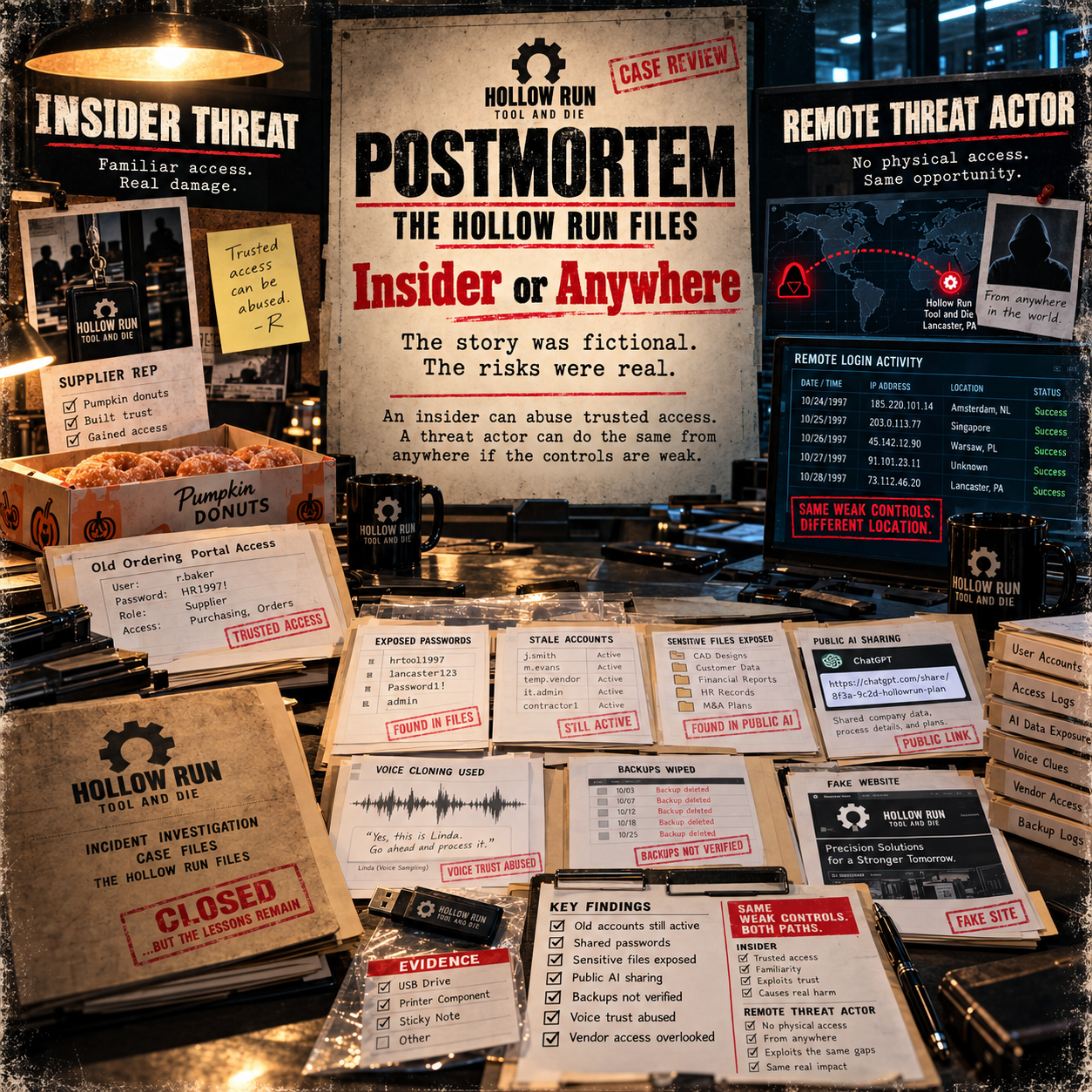
The Post-Mortem: How It All Happened

How Ray pulled it off, how someone on the other side of the world could do the same thing, and what stops each step.

Post-mortem artwork: Insider or Anywhere

Ray is in custody, Frank has a new supplier, and Hollow Run's backups are working for the first time in five years. Now for the part I've been waiting to write: how all of this actually happened.

Ray had one big advantage. He was trusted. He walked through the front door every month for eleven years, and nobody ever questioned him. But here's the uncomfortable part. Almost nothing he did required being in the building. Swap the donuts for an internet connection, and someone on the other side of the world could have done nearly every step. Most of these tricks don't take special skill. They take patience, and a company where nobody is looking.

Here's each step, how Ray did it, how a stranger could do the same, and what stops it.

1. The forgotten printer

How Ray did it: In 2015 he offered to help Walt with scanning and set the copier to send a copy of everything to an old printer, which forwarded it all to his email every night.

How a stranger could do it: Old devices with old software are one of the easiest ways into a network. Attackers scan the internet constantly for printers, cameras, and routers that haven't been updated in years. Once they're in, a device nobody remembers is the perfect hiding spot.

What stops it: Knowing every device on your network, checking that list regularly, and actually unplugging equipment when you retire it.

2. The password on the sticky note

How Ray did it: He read it off the front desk monitor. Later, it was on the company website for anyone to zoom in on.

How a stranger could do it: They don't need the sticky note. That same password showed up in a 2019 breach of a shopping site because someone reused it at home. Breach lists are bought and sold every day, and attackers try those passwords against business logins automatically. They also guess the obvious ones, like the company name plus a year. 23 of Hollow Run's 60 accounts would have fallen to that guess.

What stops it: A password manager so every account has its own strong password, MFA on every login, and monitoring for company passwords that show up in breaches.

3. The former employee's account

How Ray did it: Jenna's account was never changed and never turned off, so he used it for everything he didn't want traced back to him.

How a stranger could do it: Dormant accounts are a favorite target. Nobody is checking that inbox, and nobody notices odd sign-ins at 2:14 AM.

What stops it: An offboarding checklist that disables accounts the day someone leaves, and someone actually reviewing sign-in activity.

4. The app in the attic

How Ray did it: When the old ordering portal's company went out of business, he bought its web address and inherited its permission to read every mailbox at Hollow Run.

How a stranger could do it: Two ways. They can buy abandoned web addresses just like Ray did, which happens more often than people think. Or they can send a convincing email asking someone to click "Accept" on a harmless-looking app. One click can hand over the same access, with no password stolen at all.

What stops it: Reviewing which outside apps have access to your accounts, removing the ones you don't use, and requiring an administrator to approve new ones.

5. Copilot and the open folder

How Ray did it: He didn't need Copilot. Using Jenna's account, he could open the folder with Frank's letter because the whole company could.

How a stranger could do it: Anyone who gets into any account at your company can ask an AI assistant to find the sensitive stuff for them in seconds. AI doesn't create the exposure. It just makes the exposure much faster to find.

What stops it: Cleaning up who can see what before turning on AI tools, and checking again after.

6. Marcus's public AI chat

How Ray did it: He read Marcus's email to Dale through the attic app and clicked the link.

How a stranger could do it: They didn't even need the email. The chat was on Google for seven months. Anyone searching for Hollow Run could have found the pricing formula.

What stops it: Approved AI tools that keep company data private, a written policy on what can and can't go into them, and a few minutes of training so people know what "Share" actually does.

7. The fake website

How Ray did it: He registered a web address with two zeros where "tool" should have two o's, copied the logo and photos, and used Marcus's formula to underbid Hollow Run.

How a stranger could do it: Exactly the same way. Lookalike addresses cost a few dollars and take minutes to set up from anywhere in the world. They're used for fake invoices, fake quotes, and phishing.

What stops it: Monitoring for lookalike web addresses, buying the most obvious ones yourself, and email settings that flag messages from outside the company.

8. The phishing emails

How Ray did it: He knew job numbers and Frank's daughter's name because he was reading the company's email.

How a stranger could do it: Inside details make phishing believable, and they're easy to collect from a compromised inbox, a company website, and social media.

What stops it: Training people to slow down and report suspicious emails (like Dale and Tasha did), plus MFA, so a stolen password alone isn't enough.

9. The USB drive

How Ray did it: He dropped it in the visitor parking spaces on his way out.

How a stranger could do it: Mail it in a package, hand it out at a trade show, or skip the drive and send the same thing as an email attachment.

What stops it: Security software on every computer that blocks unknown programs. It's what saved the shop computer at Hollow Run.

10. The backups

How Ray did it: He used Jenna's password to tell the backup system to back up nothing. The screen stayed green for five years.

How a stranger could do it: Turning off or deleting backups is one of the first things ransomware groups do once they get in, so you can't recover without paying them.

What stops it: A backup copy nobody can delete or change, and regular restore tests. If you have never restored from a backup, you don't really know whether it works.

11. The cloned voice

How Ray did it: He recorded Linda on eleven years of weekly calls, then filled in the gaps with a month of silent calls.

How a stranger could do it: AI can copy a voice from a few minutes of audio, and most people have that much online in voicemail greetings, videos, webinars, or podcasts. Faking caller ID takes even less.

What stops it: The rule Tasha rolled her eyes at. Any request to move money gets a callback to a number already on file and a code word. Big payments get a second person's approval.

What caught him

Every one of these was found during Hollow Run's onboarding, using the same steps we run for every new client: a network scan, a check for former employees' accounts, a password and MFA check, a review of outside app access, an AI access and usage check, domain monitoring, security software on every computer, a restore test, and a callback rule for payments.

None of these steps needed new or exotic tools. Most companies have simply never had anyone check.

Frank wanted to fire Marcus. Anthony asked him not to. Marcus now has an approved AI tool and a written policy, and he's helping write the next version of it. If you have a Marcus at your company, our AI Acceptable Use Policy template is a good place to start.

Thank you for following The Hollow Run Files. Hollow Run Tool & Die, its people, and Ray are fiction. Every problem in this story is real, and we find versions of them in real businesses all the time.

If you'd like to know what's in your own attic, schedule an IT Environment Review with us. We'll take a look.

Want the real-world side of the story? Start with how we run managed IT, the Microsoft 365 settings most often left open, our guide to writing rules for AI at work, and what insurers now ask about your IT.

/ A Note Before You Start

Hollow Run Tool & Die, the town of Hollow Run, and every person in this story are invented. Any resemblance to a real company is a coincidence.

The problems they face are not invented. Forgotten devices, former employees' accounts left open, shared passwords, AI tools used without guardrails, lookalike websites, and cloned voices all show up in real businesses every year, usually without anyone noticing until something goes wrong. Each episode is built around one of them.